Skip to content
JACK & TORQUE

Buying guide

Jack Stand Pads and Jack Pad Adapters

The cheapest part of the whole setup, and the one that decides whether your sill survives.

By Ryder M. · Published October 10, 2026 · Last reviewed October 10, 2026

We earn a commission when you buy through the Amazon links on this page, at no extra cost to you. It never changes which tool we put first, and we publish no price we have not verified. How this site is funded.

Jack Stand Pads and Jack Pad Adapters — ranked picks with scores and a price check for each
#PickCapacityScorePrice
1
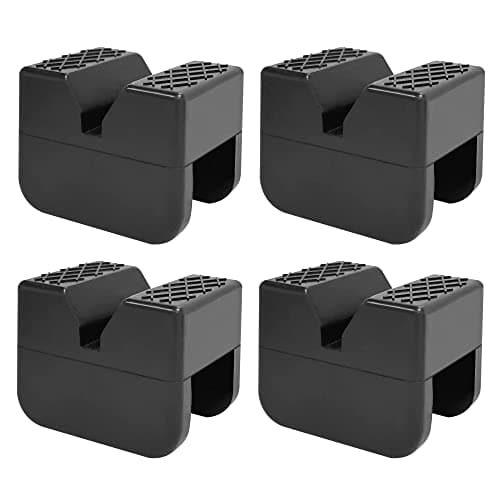
TONDA Slotted Rubber Pinch Weld Pads (4-Pack), Amazon product photo
TONDA Slotted Rubber Pinch Weld Pads (4-Pack)The pad most cars actually need
4 pads8.8
2
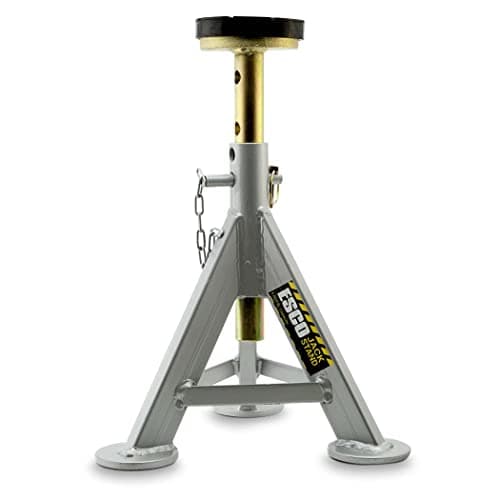
ESCO 10498 3-Ton Performance Jack Stand, Amazon product photo
ESCO 10498 3-Ton Performance Jack StandWhen the better answer is a different stand
3 ton per stand8.8
3
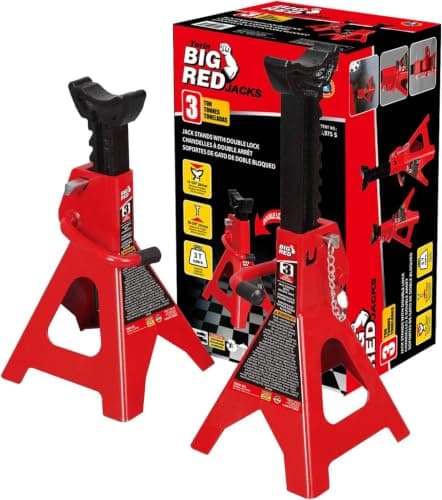
BIG RED T43002A 3-Ton Double-Locking Jack Stands, Amazon product photo
BIG RED T43002A 3-Ton Double-Locking Jack StandsThe stand these pads are usually bought for
3 ton (6,000 lb) per pair9.1

Product photographs come from each product's own Amazon listing via the Associates program. They are the seller's images, not photographs of anything we own — we have no test rig and claim none.

TONDA Slotted Rubber Pinch Weld Pads (4-Pack), Amazon product photo

Short answer: if your car has pinch welds — a folded seam running along the bottom of each sill, which is most unibody cars — buy a slotted rubber pinch-weld pad, and use it between the vehicle and the saddle of both your jack and your stands. A standard curved axle cradle resting directly on a folded seam is the single commonest way beginners put a crease in their own bodywork. If you are still choosing stands, a flat-top stand solves it at source.

What to look for before you buy anything

Lie down and look. The answer is on your own car, and there are three things you might find at the lift point.

A pinch weld

A folded, welded seam a few millimeters thick, running along the bottom of the sill, usually with notches or plastic markers indicating the designated points. This is the most common arrangement and it is what slotted pads exist for. Loading a curved cradle onto it concentrates the whole corner's weight on a seam a few millimeters wide, and the seam folds. The pinch weld guide covers the damage mode in detail, and jack stands for pinch welds ranks the stands that handle it.

A flat reinforced pad or a subframe rail

Some cars present a flat reinforced area or a boxed subframe rail instead. Here a curved cradle is still wrong — it contacts on two edges — and what you want is a flat rubber saddle, which is why the ESCO stand exists. A flat-topped pad on a conventional stand achieves the same thing.

A threaded or socketed lift point

Many European cars and most EVs have a designed lift point that takes a specific adapter — a plastic or alloy puck that locates positively in the hole. These are vehicle-specific parts and we are not going to recommend one generically: buy the adapter listed for your model, and treat any "universal" claim with suspicion.

The height every pad costs you

This is the trade-off nobody mentions, and on a low car it decides the purchase. A slotted rubber pad is typically about an inch tall. Added to a stand with an 11-1/4 in minimum, your effective lowest setting becomes 12-1/4 in — and your jack now has to lift the car an extra inch before the stand will fit under it.

How a 1 in pad changes the numbers
Without padWith a 1 in pad
BIG RED T43002A minimum11-1/4 in12-1/4 in
ESCO 10498 minimum13.2 in14.2 in
Jack lift needed to clear itStand minimum plus clearanceOne inch more again
How a 1 in pad changes the numbers

Work that against your jack's published maximum lift before you order. A jack that tops out at 14 in and a padded stand that now starts at 12-1/4 in leave a workable but narrow window. How high a floor jack lifts has every published range side by side.

How many you need

The short version

  • One pad per lift point in use. Two stands under one end means two pads, plus one for the jack.
  • The jack needs one too. The jack saddle does the same damage as a stand cradle, and it does it while the car is moving.
  • Three is the practical minimum for one-end-at-a-time work: two stands plus the jack.
  • Five if you lift all four corners: four stands plus the jack.
  • They are cheap relative to a bent sill, and a bent sill is a bodyshop quote.
  • A hockey puck is the classic improvised version and it is flat, not slotted — it protects paint but it does not stop a pinch weld folding.

The improvised versions, honestly assessed

People have been making their own for decades, and some of it works. A hockey puck is the classic: cheap, dense rubber, the right diameter for a saddle, and genuinely fine for protecting paint on a flat reinforced lift point. What it cannot do is capture a pinch weld, because it has no slot — so on a unibody car it stops the saddle scratching the seam while still pressing on it, which addresses the cosmetic half of the problem and not the structural half. A slot cut into a puck with a bandsaw is the usual next step and it does work, as long as the slot is a snug fit rather than a loose one.

A block of hardwood is the other common improvisation, and we would avoid it under a stand. Wood splits along the grain under concentrated load and it gives no warning before it does. Under a stand base, spreading load on a soft surface, a sheet of plywood is exactly right — jack stands for uneven ground covers that use. Between the saddle and the car, where the load is concentrated into a few square inches, it is the wrong material.

What a pad does not do

It does not add capacity, it does not make a stand safer, and it does not let you use a lift point your manufacturer did not designate. A pad is a load-spreading and paint-protection part, and a 1 in block of rubber between the car and the stand is one more interface that has to be sitting flat. Check it is square under the sill, not perched on an edge, every single time — a cocked pad is less stable than no pad.

It also does not replace the jack point itself. If you cannot find a designated lift point, car jack points shows where to look on a unibody car, and where to put jack stands covers the support points, which are frequently not the same places.

What we would buy

For a typical unibody car on conventional stands: three slotted rubber pads — two for the stands, one for the jack — and the knowledge that each one costs you an inch of working height. If you have not bought stands yet and your car has a flat sill or a subframe lift point, buy the ESCO 10498 instead and skip the accessory entirely; its removable flat rubber saddle is doing the same job with one fewer interface in the stack. And if your car has a designed socketed lift point, buy the adapter listed for your specific model rather than anything described as universal.

The picks in full

Every pick, in detail

TONDA Slotted Rubber Pinch Weld Pads (4-Pack), Amazon product photo

1. The pad most cars actually need

TONDA Slotted Rubber Pinch Weld Pads (4-Pack)

TONDA · score 8.8/10

Slotted rubber pads that straddle the pinch weld so the jack saddle cannot fold it over — the cheapest way to avoid the classic first-jack mistake, four to a box.

A 3 in wide, 1 in tall slotted pad that sits between any jack cradle and the vehicle, with the slot straddling the pinch weld so the saddle cannot fold it over. That slot is the whole product: a flat pad presses on the weld, a slotted one captures it and takes the load on the reinforced sill either side. Two cautions — one pad covers one lift point, so you may want two, and the 1 in it adds matters on a low car.

Published specifications

Quantity
4 pads
Type
Slotted rubber pinch-weld pad
Fitment
Sits between a jack or jack-stand saddle and the vehicle

What works

  • The slot captures the pinch weld instead of crushing it
  • Works with a jack you already own
  • Four pads covers all four lift points for the price of a coffee

What you give up

  • TONDA publishes no dimensions, so check your saddle size
  • Any pad adds height, which matters on a low car
  • Does nothing for a car without a pinch weld

Our scoring

  • Fit & reach8.6
  • Safety margin8.8
  • Beginner ease9.2
  • Build quality8.6
  • Value9.2
$11.99 · View on Amazon

#ad Price as of October 16, 2026. How this is funded

ESCO 10498 3-Ton Performance Jack Stand, Amazon product photo

2. When the better answer is a different stand

ESCO 10498 3-Ton Performance Jack Stand

ESCO · score 8.8/10

A removable flat rubber saddle instead of the usual curved axle cradle, rated 3 ton per stand and tested to ASME standards by an A2LA-certified lab.

Instead of adapting a curved cradle, this stand ships with a removable flat rubber saddle — rated 3 ton per stand over 13.2 in to 21.5 in, and ESCO states it is tested to ASME standards by an A2LA-certified facility. If you are buying stands anyway and your car has a flat sill or a subframe lift point, a flat-top stand solves the problem without a stack of accessories. 13.2 in is a tall minimum, and pin adjustment is slower than a ratchet.

Published specifications

Capacity
3 ton per stand ESCO
Height range
13.2 in – 21.5 in ESCO
Positions
10 adjustable positions ESCO
Saddle
Removable flat-top rubber cushion ESCO
Weight
11.4 lb ESCO
Testing
Tested to ASME standards by an A2LA-certified facility ESCO

What works

  • Flat rubber saddle sits against a sill or subframe without digging in
  • Rated per stand rather than per pair — easier to reason about
  • Third-party ASME testing named on the manufacturer listing

What you give up

  • 13.2 in minimum is the tallest low setting of the car stands here
  • Pin-and-post adjustment is slower than a ratchet
  • The most expensive stand in this set

Our scoring

  • Fit & reach8.4
  • Safety margin9.4
  • Beginner ease8.2
  • Build quality9.2
  • Value7.8
$69.99 · View on Amazon

#ad Price as of October 16, 2026. How this is funded

Specifications published by ESCO — we earn nothing from that link.

BIG RED T43002A 3-Ton Double-Locking Jack Stands, Amazon product photo

3. The stand these pads are usually bought for

BIG RED T43002A 3-Ton Double-Locking Jack Stands

Torin (BIG RED) · score 9.1/10

A ratchet bar plus a separate safety pin — two independent locks instead of one — at the height range a car actually needs, and Torin states they meet ASME safety standards.

A conventional ratchet-and-pin stand with a curved cradle, 3 ton per pair over 11-1/4 in to 16-3/4 in, and Torin states they meet ASME safety standards. It is here because it is the stand most people own, and the curved cradle is exactly the geometry that wants a pad on a unibody car. Read the rating as per pair, not per stand.

Published specifications

Capacity
3 ton (6,000 lb) per pair Torin
Min height
11-1/4 in Torin
Max height
16-3/4 in Torin
Base footprint
7-11/16 in x 6-7/8 in Torin
Standards
Meets ASME safety standards Torin

What works

  • Two independent locking mechanisms, not one
  • 11-1/4 in to 16-3/4 in matches what a 3-ton floor jack can reach
  • The cheapest way to buy a genuinely double-locked stand

What you give up

  • Rated per pair, not per stand — read the rating before loading two corners
  • 11-1/4 in minimum is taller than some low cars want
  • Torin's own listing says this size is not intended for SUVs or trucks

Our scoring

  • Fit & reach8.6
  • Safety margin9.2
  • Beginner ease9.0
  • Build quality8.2
  • Value9.4
$35.99 · View on Amazon

#ad Price as of October 16, 2026. How this is funded

Specifications published by Torin (BIG RED) — we earn nothing from that link.

Method

How these picks were chosen

We did not test these tools. We do not run a laboratory, we have not loaded a jack to failure or checked a wrench on a calibration bench, and we will not tell you otherwise. What we did instead is read the published manufacturer specifications, check the figures that matter against the safety standard that applies to portable automotive lifting equipment, and work out which tool suits which job. Every number on this page links to where it came from, so you can check us.

The five things we score are the five that decide a first purchase: will it fit under and lift your car, how much safety margin the rating and the locking mechanism leave you, how hard it is to get right alone in a driveway, what the materials and published standards say about how long it lasts, and what the money buys against the rest of the field.

Read the full method — including how we pick a top pick, and how prices get on the page.

Questions

Frequently asked questions

+Do I need jack stand pads?

If your car has pinch welds and your stands have curved axle cradles, yes — that combination is what folds sheet metal. If your stands have flat rubber saddles and your car has a flat reinforced lift point, you do not.

+Can I use a hockey puck as a jack pad?

For paint protection on a flat lift point, it works and people have done it for decades. On a pinch weld it does not solve the actual problem, because a flat puck still presses on the seam. The slot is what makes a pinch-weld pad work.

+How many jack pads do I need?

One per lift point in use, including the jack. Two stands under one end plus the jack is three. All four corners plus the jack is five. They are cheap relative to the bodywork they protect.

+Do jack pads reduce how low my stands can go?

Yes, by their own height. A 1 in pad turns an 11-1/4 in stand minimum into 12-1/4 in, and your jack has to lift the car an inch further to clear it. On a low car with a short-stroke jack, that inch can be the whole margin.

+Are universal jack pad adapters any good?

Slotted pinch-weld pads are genuinely generic, because they sit between the saddle and the sill and do not locate into anything. Adapters for designed socketed lift points are not — buy the part listed for your model, because a puck that does not locate positively is worse than none.

Sources

Where these figures come from

Read next

Related reading