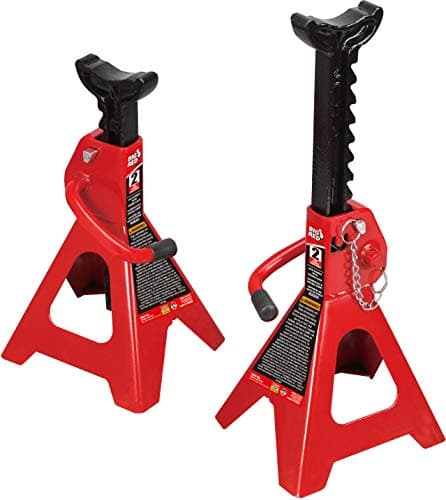
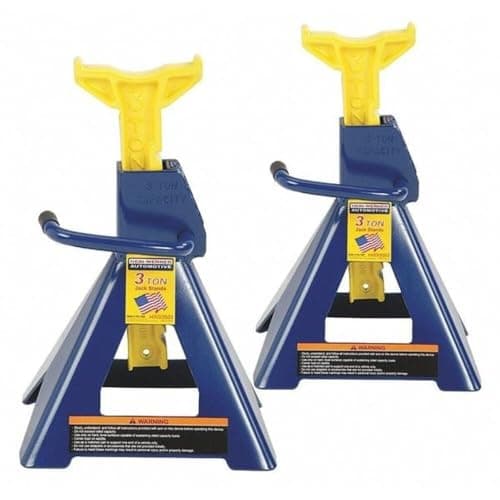
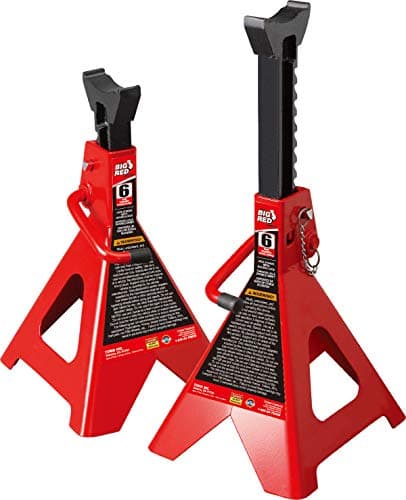
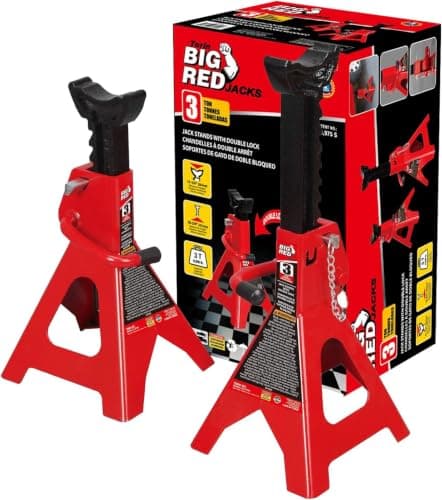
Short answer: the Torin BIG RED T43002A for most cars - a ratchet bar with a separate safety pin, 11-1/4 in to 16-3/4 in, and a stated ASME claim. The budget pick is the T42002A, which is both the cheapest set here and the only one whose maker names an edition of the standard (ASME PASE-2019), and which starts lower at 10.8 in. If you want the finest height steps, the Hein-Werner HW93503 ratchets in 11/16 in increments. For a truck, the 6-ton T46002A is the same mechanism at frame height.
What we judged these on
1. Whether there is a second lock behind the ratchet
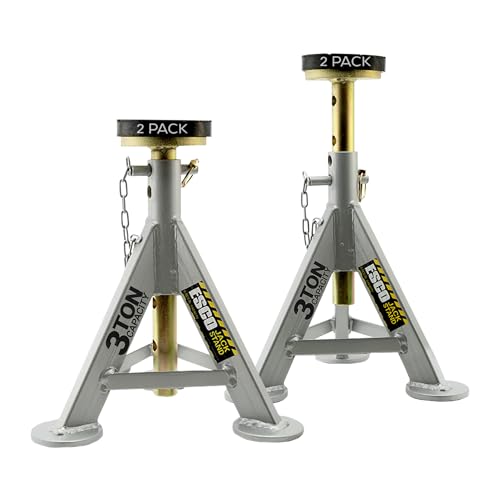
A published fact rather than a judgment. Torin publishes a ratchet plus safety pin on the T43002A and T46002A, and a 10-level ratchet bar plus a double locking pin on the T42002A. Hein-Werner publishes a ratchet bar with no secondary pin. ESCO publishes a pin with no ratchet. A pawl is a small spring-loaded part engaging a few teeth; a pin behind it carries nothing until the day the pawl does not hold. The second lock normally costs nothing extra, and the component it backs up is the one holding a car above your chest.
2. How fine the steps are
Two stands set to different notches put a car on a twist. Hein-Werner publishes 11/16 in increments, the finest here. Torin publishes a 10-level bar on the T42002A across a 10.8 in to 16.5 in range, which works out at coarser steps. ESCO publishes 10 positions across 13.2 in to 21.5 in, coarser again. Finer steps mean you can match the two sides and also fine-tune to the exact height your jack can reach.
3. The height range, against your car and your jack
A stand that will not go low enough cannot be slid under the sill; one that will not go high enough leaves you in a gap you cannot work in. And the jack has to out-lift the notch you intend to use, because the car gets raised past the stand before it comes down on it. Arcan publishes 18 in of maximum lift on the A20019, which clears the 16-3/4 in top setting of the 3-ton Torins comfortably and does not come close to the 23-13/16 in top of the 6-ton set. What size jack stands do I need works the arithmetic.
4. What the standards claim actually says
Jack stands in the US are covered by ASME PASE, and the wording matters more than the presence. "Complies with ASME PASE-2019" names an edition. "Tested to meet ASME standards" asserts testing without naming the lab. "Tested to ASME standards by an A2LA-certified facility" names the accreditation. No statement means exactly that. All four appear on this page, and the strongest paper belongs to the cheapest set and to a stand that is not a ratchet at all.
The five on published mechanism
| Stand | Mechanism | Steps | Height range | Standards claim |
|---|---|---|---|---|
| Torin T43002A (3 ton) | Ratchet + safety pin | Not published | 11-1/4 - 16-3/4 in | Meets ASME |
| Torin T42002A (2 ton) | Ratchet + double locking pin | 10 levels | 10.8 - 16.5 in | ASME PASE-2019 |
| Hein-Werner HW93503 (3 ton) | Ratchet only | 11/16 in | 11-1/2 - 17 in | None published |
| Torin T46002A (6 ton) | Ratchet + safety pin | Not published | 15-3/8 - 23-13/16 in | Tested to meet ASME |
| ESCO 10498 (3 ton) | Pin, no ratchet | 10 positions | 13.2 - 21.5 in | ASME testing, A2LA lab |
No stand wins every column. The finest steps belong to a stand with no second lock; the best-documented testing belongs to a stand with no ratchet. That is why this page ends with a recommendation rather than a winner on points.
Using a ratchet bar properly
Set both stands to the same notch on the bench, before either goes under the car - counting teeth on the floor with a car overhead is how mismatched heights happen. Put them under a published lift point, not a convenient flat spot. Lower the car slowly until the saddle takes the load and the bar seats fully on a tooth, not between two. Then insert the pin if the stand has one, leave the jack in light contact as a third member of the load path, chock the wheels still on the ground, and push the car hard at a corner. How to use jack stands safely is the procedure in full, and where to put jack stands covers the part that matters more than the mechanism.
What we left out, and why
We have not load-tested any stand on this site and will not imply we have. Every figure above is published by the manufacturer or an authoritative retailer and linked in the sources; the ranking is editorial judgment applied to those figures, and how we review says exactly what that is worth. We also left out screw-type trestles sold for trailers and caravans: they are not automotive service stands, they are not covered by the same standard, and they do not belong under a car.
What we would buy
The T43002A for a normal car, with the pin treated as mandatory rather than optional. The T42002A if the car sits low or the budget is tight - it is the cheapest set here and carries the strongest standards wording on the page. The HW93503 if you value the 11/16 in steps and accept that there is no pin behind the bar. The T46002A for a truck. And if the whole ratchet idea does not appeal, the ESCO 10498 is a defensible different answer rather than a worse one.