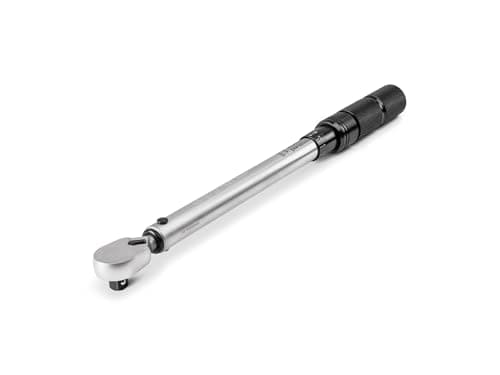
Short answer: the TEKTON TRQ51402, a 3/8 in drive wrench covering 10 to 100 ft-lb. An oil drain plug is torqued to a modest figure — on most cars well below the 40 ft-lb that a typical 1/2 in drive wrench starts at — so the 1/2 in wrench bought for lug nuts physically cannot be dialed to it. A 3/8 in wrench puts the drain plug figure in the comfortable middle of its scale. If the filter is a cartridge type with a torqued housing cap, add the 1/4 in TEKTON TRQ50402 for the in-lb figures that neither of the bigger wrenches can resolve.
Why your lug nut wrench will not do this job
This is the whole point of the page and it is arithmetic rather than opinion. Lug nuts are torqued to figures that put them in the middle of a 1/2 in drive wrench's range — which is why that is the wrench everybody buys first. A drain plug is a much smaller fastener in much softer material, and its figure lands far lower. TEKTON's 1/2 in TRQ52402 covers 40 to 200 ft-lb. The Precision Instruments split beam covers 40 to 250 ft-lb. Neither can be set below 40 ft-lb at all, because the scale does not go there.
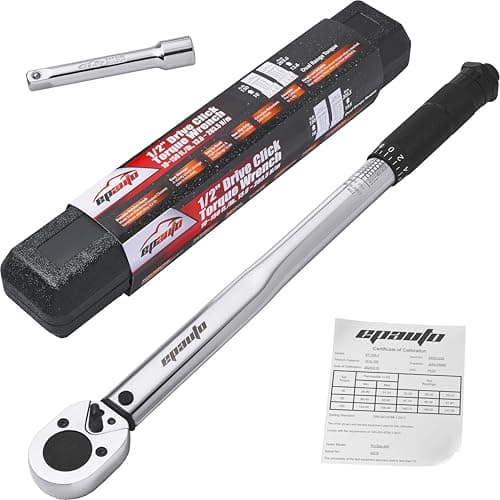
The second half of the problem is subtler and it is why the EPAuto is a compromise rather than a solution. A click wrench is least reliable at the very bottom of its scale, and makers say so in their own specifications: GEARWRENCH publishes its ±2% figure for 20 to 100% of scale, which is an explicit statement that the bottom fifth of the range is outside the warranted band. A drain plug figure on a 10 to 150 ft-lb wrench sits right in that bottom fifth. On a 10 to 100 ft-lb wrench it does not. What size torque wrench do I need generalizes this into a buying rule.
The four wrenches on published range and accuracy
| Wrench | Drive | Range | Increments | Published accuracy |
|---|---|---|---|---|
| TEKTON TRQ51402 | 3/8 in | 10 – 100 ft-lb | Not published | Not published |
| EPAuto 1/2 in click | 1/2 in | 10 – 150 ft-lb | 1 ft-lb | Pre-calibrated to 4% |
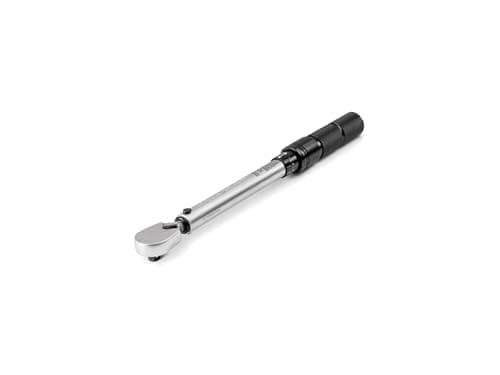
| TEKTON TRQ50402 | 1/4 in | 20 – 200 in-lb | 1 in-lb | ±3% CW/CCW, ISO 6789-1 |
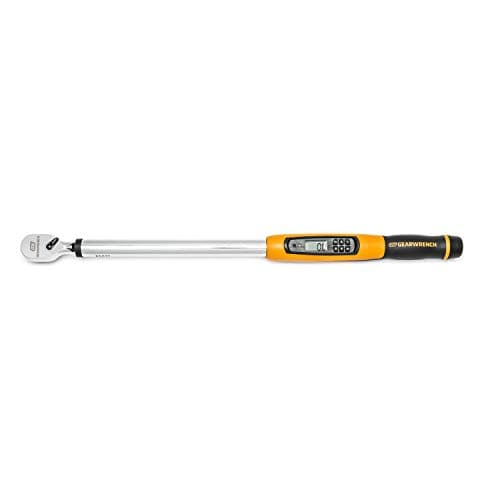
| GEARWRENCH 85077 | 1/2 in | 25 – 250 ft-lb | Digital readout | ±2% CW over 20-100% of scale |
Read the range column against your manual's figure and discard anything that cannot reach it — then, of what is left, prefer the wrench whose scale puts your figure near the middle rather than at the very bottom. That single rule is most of torque wrench buying.
What actually gets torqued during an oil change
Fewer things than people expect, and they are not all in the same units. The drain plug is the one that matters, because it threads into the sump — often aluminum — and an overtightened plug strips threads that cost far more to repair than the oil change saved. A cartridge filter housing has a torqued cap, usually specified in Nm or in-lb, which is the case the 1/4 in wrench exists for. A spin-on filter is generally not a torque wrench job at all: the instructions printed on the filter govern, and they normally describe hand-tightening to contact and then a defined further turn.
The underbody panel fasteners you removed to reach the plug are the fourth item, and they are low-figure plastic or sheet-metal fixings that a 1/2 in wrench will shear long before it clicks. If you want one honest summary of the oil change tool question rather than the torque slice of it, the first oil change tool list is the complete floor-beside-you list.
Using it without ruining the plug
1.Look the figure up before the car goes in the air
Owner's manual or manufacturer service information, written down. Doing this while lying under a car with oil draining is how people end up guessing.
2.Use the washer the manufacturer specifies
Most drain plugs seal on a crush washer or an O-ring that is designed to deform once. Re-using a flattened washer is the most common cause of a plug that weeps at the correct torque, and the usual response — another quarter turn — is what strips the sump.
3.Start the plug by hand, several turns
If it does not run in easily by fingers, stop. A cross-threaded plug will still click at the set torque and will still leak.
4.Pull smoothly to the click, once
One slow, steady pull with your hand on the grip, not out at the end of the handle, and stop at the first click. A second click is a second application of torque on top of the first. Does a torque wrench click once or twice? covers why that matters.
5.Wind a click wrench back down before you put it away
Park Tool's published use-and-care guidance for click wrenches is to return the setting to the low end of the scale for storage, so the internal spring is not held compressed. A split-beam wrench does not need this.
What we would buy
If you already own a 1/2 in wrench for lug nuts: add the TEKTON TRQ51402, and the drain plug stops being a guess. If you own nothing yet and can only buy one tool: the EPAuto, because 10 to 150 ft-lb is the only single range here that covers both a drain plug and a lug nut — accepting that the drain plug sits at the bottom of its scale. If your car uses a cartridge filter with a torqued housing cap: the 1/4 in TEKTON TRQ50402 as well, because in-lb figures are outside every other wrench here. And if you were about to buy the GEARWRENCH for this job, do not — buy it for lug nuts and suspension work, where its published accuracy band actually applies.