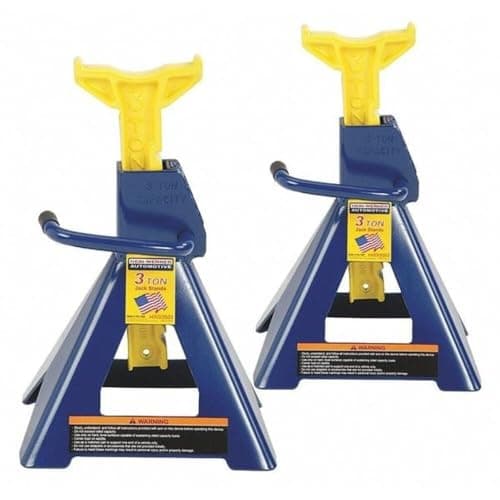
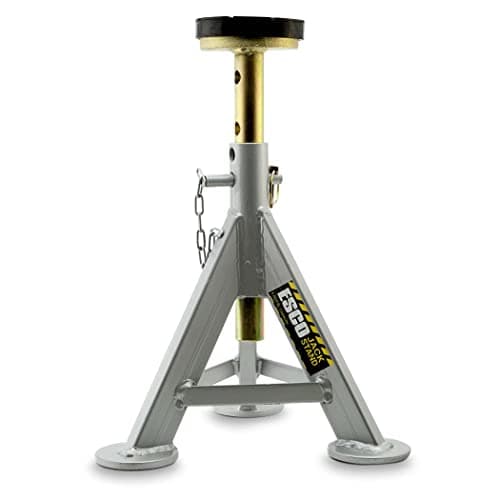
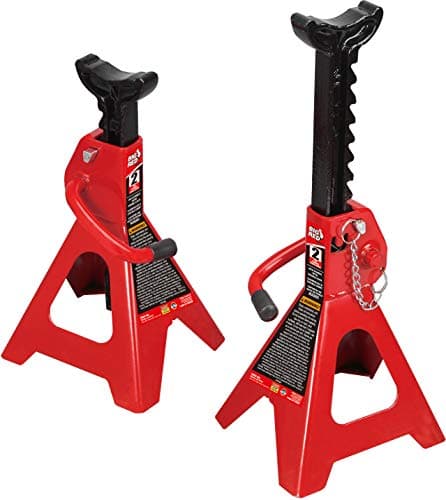
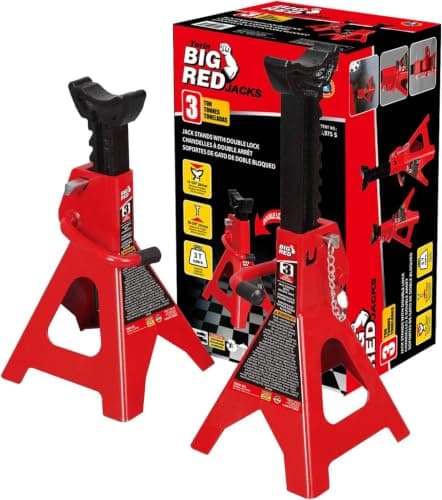
Short answer: for an oil change you need two jack stands, placed under the front of the car, both set to the same height. The BIG RED T43002A is the set most people should buy: double-locking, 11-1/4 in to 16-3/4 in, and Torin states it meets ASME safety standards. If your car sits low, the 2-ton T42002A starts about half an inch lower. If it has pinch welds you care about, the ESCO 10498 has a flat rubber saddle instead of a notched cradle.
Two stands, not four
An oil change needs the front of the car raised enough to reach the drain plug and the filter, and nothing else. The rear wheels stay on the ground, chocked, with the parking brake on. Four stands is the configuration for wheel-off work at all four corners, and it is a harder, slower setup that an oil change does not need. Two stands under the front jacking points, set to the same notch, is the standard answer.
That is also why the oil change is the job where ramps compete seriously. Ramps need no jack points and no height matching. Stands win when you want the wheels free afterwards, or when your car is too low to drive onto a 17-degree ramp.
The four sets, by the numbers
| Stand | Height range | Capacity basis | Locking |
|---|---|---|---|
| BIG RED T43002A | 11-1/4 - 16-3/4 in | 3 ton per pair | Ratchet + safety pin |
| Hein-Werner HW93503 | 11-1/2 - 17 in | 3 ton | Ratchet, 11/16 in steps |
| ESCO 10498 | 13.2 - 21.5 in | 3 ton per stand | Pin, 10 positions |
| BIG RED T42002A | 10.8 - 16.5 in | 2 ton each | Sawtooth ratchet plus pin |
Two columns in that table do most of the work. The height range tells you whether the stand will fit in the gap your jack can create; the capacity basis tells you what the headline number actually means. A stand rated "3 ton per pair" is a 1.5-ton stand, and a stand rated "3 ton per stand" is twice that. They are often printed in the same size type.
Why minimum height is the spec that decides it
The sequence on an oil change is: jack the car up, slide a stand underneath, lower the car onto it. That only works if the jack can lift the car higher than the stand's lowest setting, with enough margin to get the stand in position. A jack that reaches 18 in and a stand that starts at 11-1/4 in leave plenty of room. A low car that your jack can only raise 12 in, and a stand that starts at 13.2 in, do not work together at all — and you discover it with the car in the air.
Measure the gap your jack actually creates on your car before you choose. The weight ratings page covers the capacity side of the same decision, and jack stands for low cars is the version of this page for anything slammed.
Matching the two stands
Both stands must be on the same notch. On a ratchet stand you can count teeth; on a pin stand you count holes. The Hein-Werner's 11/16 in increments make this easy and precise, which is a real advantage on a job where the car needs to be level for the sump to drain. A car sitting nose-down or twisted leaves oil in the pan and makes the fill level wrong when you check it afterwards.
The short version
- Set both stands to the same notch before the car goes anywhere near them.
- Place them under the manufacturer's rated support points, not under the floor pan.
- Chock both rear wheels and set the parking brake before lifting.
- Lower the car fully onto the stands, then shake the bumper hard before going under.
- Keep the floor jack lightly in contact as a backup, carrying no load.
Where the stands go on an oil change
On most unibody cars the front support points are reinforced areas of the sill just behind the front wheels, marked by a notch, an arrow or a triangle in the plastic. They are the same points the owner's manual names for the emergency scissor jack. Subframe rails are often also rated, but only where the manual says so — a floor pan or a suspension arm is not a support point. The where to put jack stands reference walks through identifying them on an unfamiliar car, and car jack points covers the markings themselves.
If the support point is a bare pinch weld, the flat saddle on the ESCO is worth the money, or add a slotted pad to whichever stand you already own. A folded pinch weld is cosmetic damage on day one and a rust path two winters later.
What we would buy
For a first oil change on a normal car: the T43002A, plus a pair of wheel chocks and a jack that can reach 11-1/4 in with margin. For someone who expects to do this twice a year for a decade, the Hein-Werner is the better tool and the finer adjustment earns its price. For a low car, the T42002A is the one that physically fits. For a car where the only rated support is an exposed pinch weld, the ESCO. All four are enough stand for one corner of a passenger car; the choice is about fit, not strength.