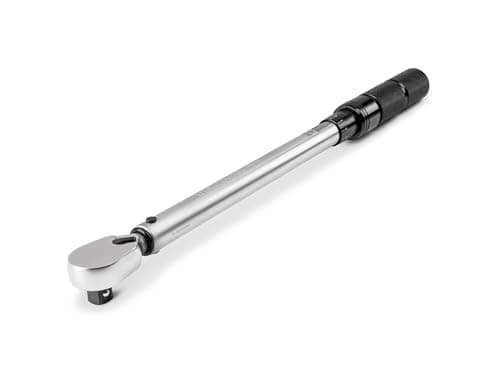
Short answer: there are five mechanisms — beam, click (micrometer), split beam, electronic, and preset or torque-limiting — and three drive sizes that matter on a car: 1/4 in, 3/8 in and 1/2 in. For a first purchase, buy a 1/2 in click wrench. It is the mechanism that signals hands-free, it is the drive size that reaches wheel figures, and everything else on this page is either a refinement of it or a tool for a job it cannot do. The mechanism matters far less than owning the right drive size, which is the mistake most first buyers actually make.
The short version
- Beam: a deflecting pointer against a scale. Cheapest, nothing to adjust, nothing to drift — but you have to watch the scale while you pull.
- Click (micrometer): a preloaded spring that breaks over audibly at the set figure. The default. Must be wound down to store.
- Split beam: clicks like a click wrench, holds its setting with a cam and beam instead of a compressed spring. No storage routine.
- Electronic: a strain gauge and a display. The only type in our registry whose maker publishes an accuracy percentage, and the only one that reads out in several unit systems.
- Preset and torque-limiting: drivers and sticks built to stop at one figure or a narrow band, for small fasteners and for impact guns.
1. Beam (deflection) wrenches
The original and the simplest: a lever with a calibrated flexible beam and a pointer. The beam bends under load, the pointer does not, and you read the deflection against a printed scale as you pull. There is no spring to preload, no mechanism to set and nothing to wind back afterward, which means there is very little that can go out of adjustment.
The weakness is ergonomic rather than mechanical. You have to see the scale at the moment you reach the figure, and in a wheel arch, under a car on stands, or with the handle pointing away from you, frequently you cannot. There is also no signal: nothing tells you to stop except your own eyes. Beam vs click torque wrench goes through that trade in full.
We do not rank a beam wrench among our picks, and the reason is a research limit rather than a verdict on the mechanism: the beam wrenches we found in current production do not publish an accuracy figure we could cite, and we will not rank a measuring tool on an unsourced number. If you already own one, it is a perfectly legitimate tool — read the scale carefully and keep it straight.
2. Click, or micrometer, wrenches
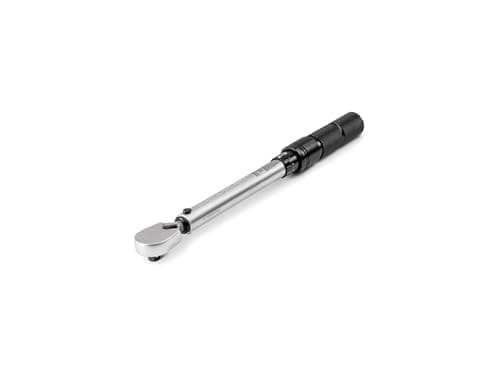
This is what most people mean by "torque wrench", and what almost every wrench sold at consumer money is. You dial a figure into a handle that compresses a coil spring against a pivoting lever; at the set torque the lever breaks over with a sharp click you both hear and feel, and you stop. It is mature, cheap and accurate, and the hands-free signal is the single biggest practical advantage any mechanism on this page has.
It has one maintenance requirement, and it is the one most home garages skip: the wrench should be returned to the low end of its scale before it goes in the drawer, because the preload the scale depends on is a compressed spring. Park Tool publishes that as care guidance. Our click picks span the field — TEKTON at 40 to 200 ft-lb for wheels, a 3/8 in TEKTON at 10 to 100 ft-lb for brake hardware, and EPAuto's 10 to 150 ft-lb wrench at the cheapest money that still comes with a published accuracy claim.
3. Split beam wrenches
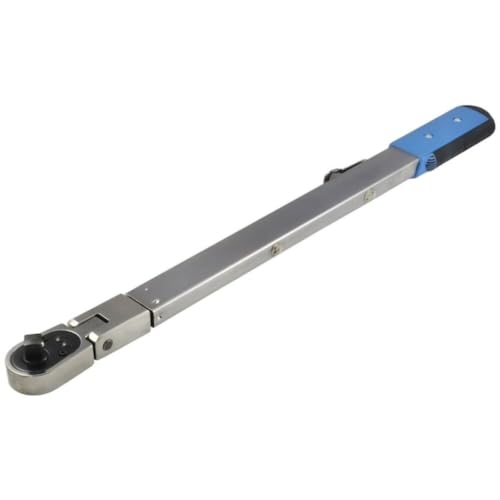
A split beam is not a beam wrench with a different name; it is a third mechanism. You set a figure by moving a cam, and at that figure a deflecting beam releases with an audible break, much like a click wrench. What it does not have is a coil spring held under compression between uses — so the storage routine stops mattering, which removes the commonest reason a home-garage wrench quietly stops reading true.
Precision Instruments publishes ±4% for the C3FR250F and ships it with a dated calibration certificate, which is the only piece of paper in this category that tells you when the tool was verified. The costs are coarser adjustment (5 ft-lb steps against 1 ft-lb on a cheap click wrench) and professional pricing. Split beam vs click torque wrench is the head-to-head.
4. Electronic (digital) wrenches
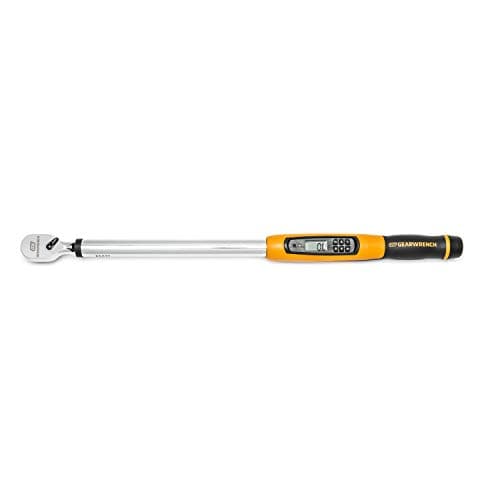
A strain gauge, a processor and a display. You key in a target and the wrench warns you as you approach it — GEARWRENCH uses vibration, a buzzer and an LED together on the 85077 — then records the peak. Two things follow from the design. First, accuracy becomes publishable, and GEARWRENCH does publish it: ±2% clockwise and ±3% counter-clockwise, stated over 20 to 100% of scale rather than across the whole range, which is a caveat worth reading rather than skipping. Second, unit conversion stops being your problem, because the display switches between ft-lb, in-lb, Nm, kg-m and kg-cm.
The costs are batteries, a calibration warranted for 90 days, and a price several times a click wrench. Click vs digital torque wrench works through whether that is worth it on a car you service yourself.
5. Preset, adjustable-driver and torque-limiting tools
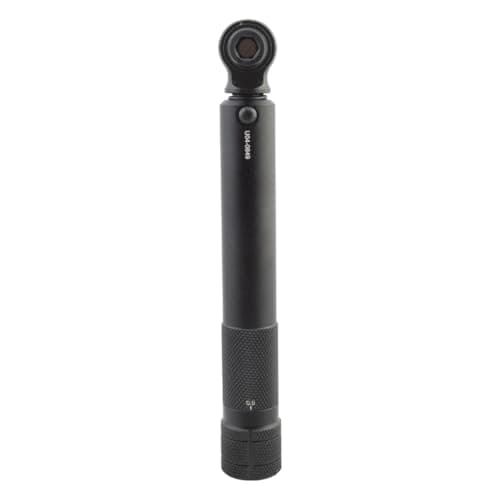
The last family is the one people forget exists, and it covers the fasteners where the risk is not leaving a wheel loose but snapping a bolt or cracking a plastic housing. Small ratcheting drivers set in newton meters — the Topeak Torq Stick in our picks is 2 to 10 Nm at ±4% — cover the low figures a 1/2 in wrench physically cannot read. Dedicated bike wrenches like Park Tool's TW-5.2 and TW-6.2 sit in the same band for component work.
The other member of this family is the torque stick: a torque-limiting extension used on an impact gun, which twists and stops transmitting past roughly a nominal figure. These are a tire-shop production tool, not a measuring instrument, and we do not rank one — no maker we found publishes an accuracy band for them, and the whole point of a torque figure is knowing what you applied. Torque wrench vs impact wrench covers why an impact gun is a removal tool and a torque wrench is the installation tool.
The five mechanisms side by side
| Type | How you know you are there | Published accuracy | Wind down to store? | Our pick |
|---|---|---|---|---|
| Beam (deflection) | You read a scale while pulling | Not published by any model we found | Nothing to wind | None — see above |
| Click (micrometer) | Audible and tactile break | EPAuto: pre-calibrated to 4%; TEKTON: not published | Yes | TEKTON TRQ52402 |
| Split beam | Audible break | ±4% | Not needed | Precision Instruments C3FR250F |
| Electronic | Vibration, buzzer and LED, plus a readout | ±2% CW / ±3% CCW, 20-100% of scale | No spring | GEARWRENCH 85077 |
| Preset / small driver | Audible click at the set figure | ±4% | Varies by tool | Topeak Torq Stick |
Drive sizes: the decision that matters more than mechanism
A torque wrench can only be trusted inside its own range, and the range is set by the drive size far more than by the mechanism. Setting a 1/2 in wheel wrench to a drain-plug figure near the very bottom of its scale is the most common way a careful beginner gets a wrong number — the bottom 20% of a scale is exactly the region makers either exclude from their accuracy statement or do not speak about at all.
| Drive | Our pick | Published range | What it is for |
|---|---|---|---|
| 1/4 in | TEKTON TRQ50402 | 20 – 200 in-lb | Spark plugs, sensors, valve covers, plastic trim |
| 3/8 in | TEKTON TRQ51402 | 10 – 100 ft-lb | Brake caliper hardware, drain plugs, accessory brackets |
| 1/2 in | TEKTON TRQ52402 | 40 – 200 ft-lb | Lug nuts, suspension, driveline |
Two of those three overlap usefully. A 3/8 in wrench reaching 100 ft-lb can do lug nuts on a small car in a pinch, and a 1/2 in wrench starting at 10 ft-lb, like the EPAuto, covers brake hardware. That overlap is why the honest buy order is one wrench, then a second in a range the first cannot reach. What size torque wrench do I need maps ranges to jobs in detail, and best torque wrench sets covers buying ranges together rather than one at a time.
Units: the third axis, and the cheapest mistake to make
Torque is published in pound-feet in the US, newton meters nearly everywhere else, and inch-pounds for small fasteners. The conversion is fixed — NIST gives 1 lbf·ft as 1.355 818 N·m — but the mistake people make is not arithmetic. It is reading the wrong one of two scales printed on the same analog handle, which is how a 90 Nm figure gets set as 90 ft-lb: about a third too tight. Torque wrench Nm to ft-lb covers that specific error. An electronic wrench sidesteps it by displaying one unit at a time.
So which type should you buy?
1.Buy a 1/2 in click wrench first
It reaches wheel figures, it signals hands-free, and it is the cheapest mechanism that does both. Wind it down to the bottom of its scale every time you put it away.
2.Choose split beam instead if you know you will skip that step
Same accuracy class, no spring held under load, and a dated calibration certificate in the box. You pay for it in price and in coarser adjustment.
3.Choose electronic if you want a published accuracy figure or work in mixed units
±2% clockwise over 20 to 100% of scale is the best specification on this page, and switching units on the display removes the dual-scale misreading entirely.
4.Add a small drive second, not a second mechanism
A 3/8 in or 1/4 in wrench covers figures your first wrench cannot read at all. That is a real capability gain; a second 1/2 in wrench in a different mechanism is not.
5.Check it, whichever type you bought
A torque wrench is a measuring instrument and it can be wrong without looking wrong. How to check torque wrench calibration is the test you can do at home.
The verdict
Five mechanisms, and only one of the distinctions between them is likely to change the outcome of your first wheel job: whether the tool signals for you. That rules the beam wrench out for most people and leaves click, split beam and electronic, which differ on storage discipline, resolution and whether anybody publishes an accuracy figure. Pick on that, then spend the rest of your attention on drive size and range, because owning a wrench that cannot reach your fastener's figure is a bigger problem than owning the second-best mechanism. Best torque wrenches ranks the whole field if you would rather start from a shortlist.