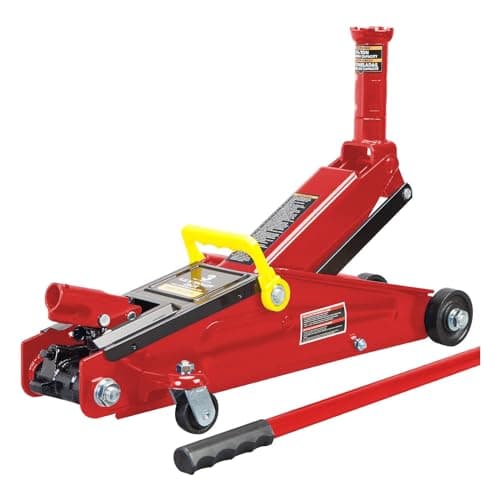
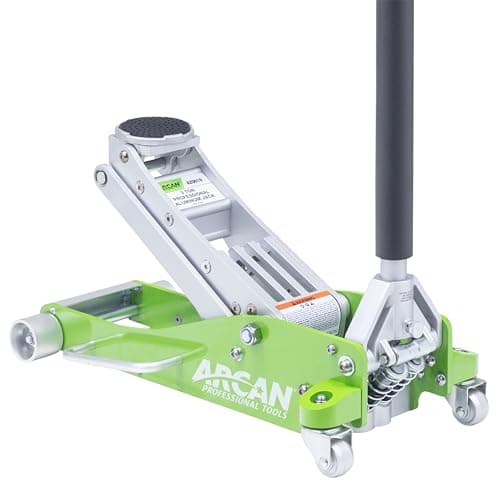
Short answer: on published figures the DAYTONA DS300LP is the better jack, and it is the cheaper one. It starts lower (3-1/8 in against 3.75 in), finishes higher (19-7/8 in against 18 in) and its listing carries a line Arcan's does not: "Complies with ASME-PASE standards." The Arcan A20019 wins on exactly two things, and whether they are worth the premium is a question about you rather than about the jacks — it weighs 23 lb less, and it arrives at your house.
The published figures, side by side
Every number below comes from the maker's own page, linked at the foot of this comparison. Neither jack has been in our hands; we do not run a lab, and how we review says so.
| Specification | Arcan A20019 | DAYTONA DS300LP (64240) |
|---|---|---|
| Capacity | 3 ton (6,000 lb) | 3 ton (6,000 lb working load) |
| Minimum height | 3.75 in | 3-1/8 in |
| Maximum height | 18 in | 19-7/8 in |
| Weight | 56 lb | 79 lb |
| Material | Aircraft-grade aluminum | Steel |
| Standards | No PASE statement published | "Complies with ASME-PASE standards" |
| Overload protection | Bypass and overload valves published | Not stated on the listing |
| Warranty | 1 year | 90 days |
| How you buy it | Delivered | Harbor Freight, oversized item |
Two of those rows will decide this for most people, and they are not the two anybody argues about online. The capacity figures are identical and neither is the limit on a car corner anyway — our capacity guide works through why 2 ton is already more than a sedan puts on a jack. What actually differs is 1.6 in of range and 23 lb of mass.
Where the Daytona wins, and it is not close
It goes lower and higher. 3-1/8 in at rest is low enough for most unmodified cars, and 19-7/8 in at full extension clears a wheel on a crossover with room to spare for the stands. That is a genuinely wider working window than the Arcan's 3.75 in to 18 in, at both ends of the stroke.
It publishes a standards claim. Harbor Freight's certification field on this listing reads "Complies with ASME-PASE standards". ASME PASE is the US safety standard for portable automotive service equipment — a named document with a defined test regime, not an adjective — and a company that prints that line is making a checkable assertion rather than a marketing one. Arcan does not publish an equivalent statement for the A20019. We treat that gap the same way our safest floor jacks page does: named compliance beats a described mechanism, which beats an adjective.
It costs less. Harbor Freight publishes the price on its own listing and it undercuts the Arcan comfortably. We do not print other retailers' prices here — the live figure on this page is the current Amazon price for the jacks we link — but the gap is large enough that it belongs in the decision.
Where the Arcan earns the premium
23 lb. 56 lb against 79 lb is a 29% difference, and it is the whole argument for aluminum. It is the difference between a jack you slide out with one hand and one you plant in a corner and leave there; between a jack that goes in the trunk for a track day or a friend's driveway and one that does not. If you have a flight of steps between your car and wherever the jack lives, this row is the only one that matters. Aluminum vs steel floor jacks is the longer version of this trade.
A year against 90 days. Arcan backs the A20019 for 1 year; Harbor Freight's listing guarantees this jack free from defects in materials and workmanship for 90 days from purchase. For a hydraulic tool that is a meaningful difference, because the failure people actually see — a jack that will not hold height, or seeps past a seal — tends to show up after a few months of use rather than in the first fortnight.
It publishes its overload protection. Arcan states bypass and overload valves on the specification page. Harbor Freight's listing for the 64240 does not mention a safety or overload valve at all. That is not a claim the Daytona lacks one — PASE compliance itself implies overload testing, and Harbor Freight's own owner's manuals for its other jacks discuss the safety valve explicitly. It is a note about what each page will stand behind in writing.
You can have it delivered. The Daytona is a Harbor Freight exclusive, flagged oversized on its listing and not shippable to Alaska or Hawaii. If there is no store within a sensible drive, the comparison ends there regardless of the specifications.
What neither listing tells you
Three things we would want before calling either jack the better tool, and neither maker publishes:
The short version
- Service parts. Neither page publishes a seal kit or a parts diagram. On a hydraulic jack that is the difference between a repair and a replacement after a few years.
- Saddle diameter. Arcan publishes a 4 in saddle elsewhere in its range and the Daytona listing gives no saddle figure at all, which matters when you are aiming at a pinch weld rather than a frame rail.
- Pump strokes to full height. Both jacks are sold on how quickly they rise, and neither publishes a figure you could compare.
That is the normal state of this category rather than a complaint about these two companies. It is also why we rank on the handful of specifications that are published consistently — capacity, the two height numbers, weight, material and whatever standards line a maker is willing to print.
Which should you buy?
Buy the Daytona if there is a Harbor Freight you can get to, the jack will live in one garage, and you would rather have the wider lift range and the published PASE line than the lighter chassis. On the numbers, that is the stronger jack for less money, and we would rather say so than steer you to the option we can earn a commission on.
Buy the Arcan A20019 if you will be moving the jack — between cars, into a trunk, up or down steps — or if a 1-year warranty and a published overload valve are worth more to you than 1.6 in of range, or if there is simply no Harbor Freight near you. It is still our default pick in best floor jacks, and the reason is the one above rather than anything about capacity.
Buy neither if you only ever intend to do oil changes on a car with normal ride height. Ramps are cheaper, faster and have no hydraulics to fail — floor jack vs ramps covers when that swap is the right call, and Pittsburgh vs Daytona compares the Daytona against the cheaper jack on the same shelf if Harbor Freight is where you are shopping anyway.