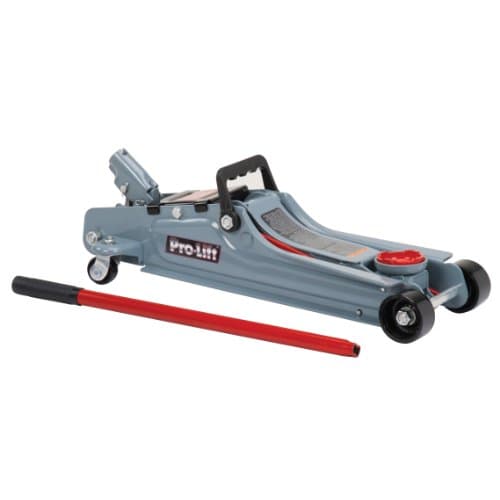
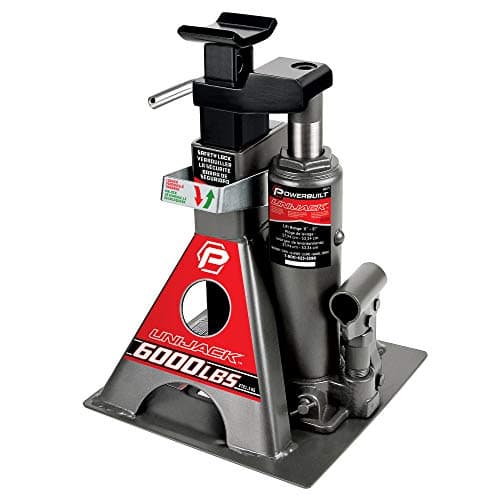
Short answer: the Pro-Lift F-757G, because at a published 22 lb it is the only jack here light enough to genuinely live in a car, and a 3-5/8 in minimum height means it fits under a stock sedan where a taller jack does not. If the vehicle is a pickup or a tall SUV, carry the Powerbuilt Unijack instead - it is the only tool on this page with an integrated locking safety bar, which means it can hold the vehicle mechanically rather than on hydraulic pressure alone.
What we judged these on
1. Published weight, which almost nobody publishes
This is the criterion that should decide a trunk jack and the one the category hides. A floor jack you have to wrestle out of a trunk at the roadside in the rain is a jack you will not use. Of the jacks on this site, Pro-Lift publishes 22 lb for the F-757G, Arcan publishes 56 lb for the A20019 and 92.59 lb for the A20016, and Hein-Werner publishes 219 lb gross for the HW93657. Pro-Lift publishes no weight for the F-767 and Torin publishes none for the T83006. Where a maker does not publish a figure we have said so rather than estimating one.
2. Minimum height, against the car it lives in
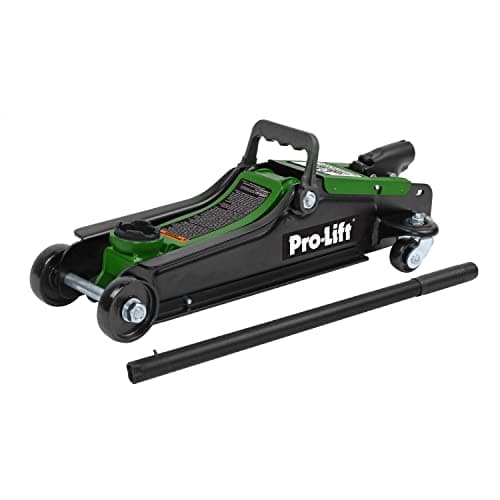
A jack that cannot get under the car is dead weight in the trunk, and the spread here is decisive: 3-1/2 in for the F-767, 3-5/8 in for the F-757G, 5-7/8 in for the Torin and 11 in for the Powerbuilt Unijack. The last two are not car jacks. Measure the gap under your own vehicle's jacking point, with the car cold and on the flat, before you buy anything. Car jack points covers finding the right spot.
3. Maximum lift, for the job you will actually do
A roadside tire change needs the wheel clear of the ground with the suspension at full droop, which is less height than a garage job needs. 13-3/8 in does that on a car. It does not seat a car high on jack stands, which is a garage requirement rather than a roadside one - and if you want the jack to do both, that is a different purchase. How high does a floor jack lift has the full range comparison.
4. Handle length, because the trunk has to close
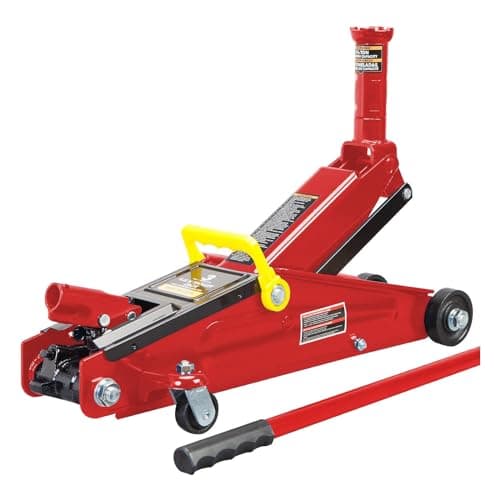
Easy to forget and genuinely annoying. Torin publishes a 24.5 in handle on the T83006, which is a feature in a garage and a problem in a sedan trunk alongside a spare wheel and a cargo cover. Two-piece handles help; so does measuring your trunk well before the jack arrives.
5. Whether it can hold as well as lift
The real safety distinction on this page. A hydraulic jack is a lifting device, and everything on this site says never to get under a car held only by one. The Powerbuilt Unijack is the exception in the sense that matters: Powerbuilt publishes an integrated locking safety bar, so the load can rest on a mechanical stop rather than on fluid pressure. For roadside work that is a meaningful advantage even though a tire change should not put you under the car at all.
The four jacks on published specification
| Jack | Capacity | Lift range | Published weight | Mechanical hold |
|---|---|---|---|---|
| Pro-Lift F-757G | 2 ton | 3-5/8 – 13-3/8 in | 22 lb | No |
| Pro-Lift F-767 | 2 ton | 3-1/2 – 14 in | Not published | No |
| Powerbuilt 620471 Unijack | 3 ton | 11 – 21 in | Not published | Yes — locking safety bar |
| BIG RED T83006 | 3 ton | 5-7/8 – 20-7/8 in | Not published | No |
Read the lift range against your own vehicle first and the weight column second. If your car needs a sub-4 in starting height, the bottom two rows are out before weight is even a question.
What else belongs in the trunk with it
A jack on its own is half a kit, and the other half is cheap. A pair of wheel chocks, because a roadside shoulder is rarely level and the parking brake only holds two wheels. A short length of flat board or a thick steel plate, because the surface at the roadside is usually asphalt, gravel or dirt rather than a garage slab, and a jack base punching into soft ground is the most common way a roadside lift goes wrong. A torque wrench if you have room, because the lug nuts you fit at the roadside should be checked to the proper figure rather than left at whatever you managed with a short wrench.
On surfaces, be realistic about the limits. Jacking up a car on gravel sets out what load spreading can and cannot fix, and the honest answer on a genuinely soft shoulder is often to move the car to firmer ground before lifting it, or to call for help. Wheel chocks guide covers the chocks, and how to change a tire safely is the procedure the whole kit exists for.
What we would buy
For a car: the Pro-Lift F-757G, on the published 22 lb and the 3-5/8 in minimum height, with the 13-3/8 in ceiling understood as a roadside limit. For a pickup, van or body-on-frame SUV: the Powerbuilt Unijack, because an 11 in minimum is fine on a truck and a mechanical locking bar is worth having when you are nowhere near a garage. For a pickup bed where height matters more than portability: the BIG RED T83006. And keep the factory jack in the car as well - it is the worst tool you own and it is also the only one guaranteed to fit the car's own jacking point.