Skip to content
JACK & TORQUE

Buying guide

Low Profile Scissor Jack

The thing you are searching for mostly does not exist. The problem behind the search has two good solutions.

By Ryder M. · Published October 10, 2026 · Last reviewed October 10, 2026

We earn a commission when you buy through the Amazon links on this page, at no extra cost to you. It never changes which tool we put first, and we publish no price we have not verified. How this site is funded.

Low Profile Scissor Jack — ranked picks with scores and a price check for each
#PickCapacityScorePrice
1
Pro-Lift F-767 2-Ton Low-Profile Floor Jack, Amazon product photo
Pro-Lift F-767 2-Ton Low-Profile Floor JackThe actual answer for a low car
2 ton7.8
2
Pro-Lift F-757G 2-Ton Floor Jack, Amazon product photo
Pro-Lift F-757G 2-Ton Floor JackLowest-cost low start
2 ton (4,000 lb)7.8
3
Black Widow Low-Profile Plastic Service Ramps (6009-V2), Amazon product photo
Black Widow Low-Profile Plastic Service Ramps (6009-V2)When no jack will fit at all
5,000 lb per axle (10,000 lb GVW)8.0

Product photographs come from each product's own Amazon listing via the Associates program. They are the seller's images, not photographs of anything we own — we have no test rig and claim none.

Pro-Lift F-767 2-Ton Low-Profile Floor Jack, Amazon product photo

Short answer: there is no meaningful low-profile scissor jack for service work, because the scissor mechanism cannot be made thin and stable at the same time. A scissor jack lifts by closing a hinged parallelogram with a threaded rod — the collapsed height is set by the length of the arms, and shortening the arms to gain clearance costs you both lift height and base width at once. If you need to get under a low car, the tool is a low-profile hydraulic floor jack, or a pair of thin ramps followed by one.

Why the mechanism cannot be low-profile

A scissor jack is a mechanical, not a hydraulic, device. Two pairs of arms pivot around a central hinge, and turning a threaded rod draws the ends together, which forces the hinge upward. Three consequences follow from that geometry, and all three work against a low-profile design.

The collapsed height is the arm length

When the jack is fully down, the arms are at their flattest, but they still have to physically fold past each other, and the nut, the rod and the base plate all sit in the stack. There is no equivalent of a hydraulic jack's thin lifting arm sliding under a sill. To get a scissor jack thinner you have to shorten the arms, which immediately caps how high it can go.

The base is small by design

A scissor jack was designed to live in a spare-wheel well, so its footprint is tiny. That is tolerable for a roadside wheel change on a flat shoulder and it is not what you want on a sloping driveway with your arms under the car. A floor jack's long chassis and four casters spread the load over a far larger area.

It is slow, and effort scales badly

Hydraulics multiply force; a threaded rod multiplies it much less. Cranking a car up by hand on a short-handled scissor jack is hard work, and hard work low to the ground is exactly where people get careless.

The longer version of this comparison, including where a scissor jack is genuinely the right tool, is at floor jack vs scissor jack.

What to look for instead

You are shopping for one published number: the jack's minimum saddle height. Everything else is secondary until that figure clears the underside of your car. Here is how to establish the figure you need, and the two routes to meeting it.

Measure first, then shop

Park on level ground. Find the pinch weld or the reinforced lift pad nearest the wheel you want to raise — see car jack points — and measure from the floor to the lowest point of the sill immediately in front of it. Then subtract about half an inch, because the saddle pad has thickness and your driveway is not as flat as it looks. That is your ceiling.

Route one: a low-profile hydraulic jack

If your figure is above roughly 4 in, a low-profile floor jack simply fits: the published minimums in that class run from about 3-1/2 in up. That is the whole purchase, and low profile floor jacks is the page that ranks them on exactly this number.

Route two: thin ramps, then the jack

If your figure is below 4 in — a lowered car, a track car, anything with a front lip — no jack on the market fits, and the answer is to drive the car up 2-1/2 to 3 in on a pair of very shallow ramps first, then roll the jack under the now-raised sill. It feels like a workaround and it is in fact the standard method. Car ramps for low cars covers the ramps, and the loading angle is the spec that decides whether your bumper survives: car ramp angle and clearance.

The three picks, and what each one is for

Published figures for every pick on this page
PickTypeKey figureWhat it solves
Pro-Lift F-767Low-profile hydraulic jack3-1/2 in – 14 in lift rangeA low car a normal jack will not fit
Pro-Lift F-757GHydraulic jack3-5/8 in – 13-3/8 in lift rangeThe same job for less money
Black Widow 6009-V2Low-profile ramps9.05 degree angle, 2-1/2 in liftA car too low for any jack at all
Published figures for every pick on this page

Note that the ramps are not an alternative to the jack. They are the first of two steps: ramps to gain clearance, jack to lift the corner, stands to hold it. On a genuinely low car you own all three.

Keep the scissor jack anyway

None of this means the jack in your trunk is useless. It is the correct tool for one specific job — a roadside wheel change, on a flat shoulder, with nothing of you under the car, where its small size and the fact that it needs no hydraulic fluid are genuine virtues. It was supplied with your car for that scenario, it is matched to your car's jacking point, and it should stay where it is. How to change a tire is that procedure.

What we would do

Measure your lift point. If the number is above 4 in, buy the Pro-Lift F-767 and a pair of stands and stop researching. If it is below 4 in, buy a pair of Black Widow 6009-V2 ramps, drive up, and then use the jack you were already going to buy. Either way, spend nothing on hunting for a low-profile scissor jack: the few listings that use the phrase are ordinary trunk jacks with a marketing adjective attached.

The picks in full

Every pick, in detail

Pro-Lift F-767 2-Ton Low-Profile Floor Jack, Amazon product photo

1. The actual answer for a low car

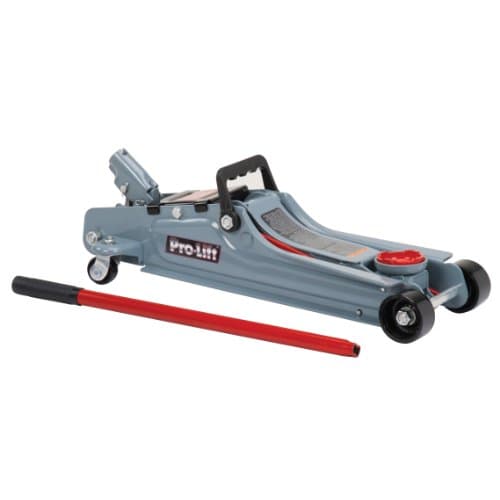
Pro-Lift F-767 2-Ton Low-Profile Floor Jack

Pro-Lift · score 7.8/10

The cheapest jack here that still starts at 3-1/2 in — but 14 in of maximum lift is the ceiling you have to plan around.

3-1/2 in collapsed, 14 in at full lift, 2 ton, with a built-in safety valve and bypass stated by Pro-Lift. This is the published minimum height that a scissor jack cannot match while still being stable, and it is the cheapest route to getting under a car that a normal jack will not fit. The 14 in ceiling is the catch: that is a sedan spec, not a crossover one.

Published specifications

Capacity
2 ton Pro-Lift
Lift range
3-1/2 in – 14 in Pro-Lift
Material
Steel Pro-Lift
Overload protection
Built-in safety valve and bypass Pro-Lift

What works

  • 3-1/2 in minimum height fits under most sedans
  • Cheapest route into a real hydraulic floor jack
  • Small enough to keep in a car trunk

What you give up

  • 14 in maximum lift is not enough for many SUVs or trucks
  • 2 ton leaves less capacity headroom than a 3-ton jack
  • Steel at this price means more flex under load than the aluminum jacks

Our scoring

  • Fit & reach7.0
  • Safety margin7.6
  • Beginner ease8.4
  • Build quality7.2
  • Value9.2
$107.99 · View on Amazon

#ad Price as of October 16, 2026. How this is funded

Specifications published by Pro-Lift — we earn nothing from that link.

Pro-Lift F-757G 2-Ton Floor Jack, Amazon product photo

2. Lowest-cost low start

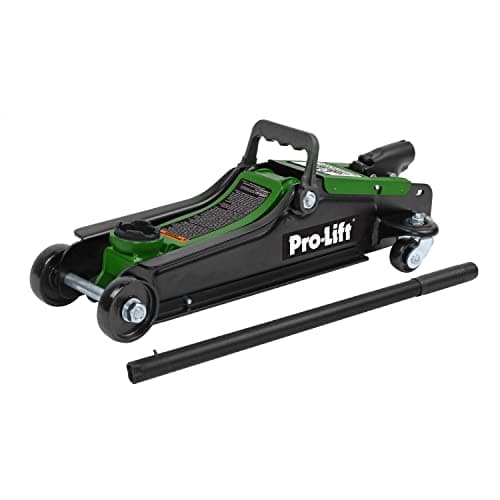
Pro-Lift F-757G 2-Ton Floor Jack

Pro-Lift · score 7.8/10

A 3-5/8 in starting height at the very bottom of the market — the rare cheap jack that actually fits under a modern sedan, bought at the cost of a 13-3/8 in ceiling.

3-5/8 in to 13-3/8 in at 22 lb, with an overload valve bypass system. An eighth of an inch taller at the bottom than the F-767 and a little shorter at the top, for less money. If the reason you searched for a scissor jack was price rather than size, this is the cheapest hydraulic jack on this site that still starts genuinely low.

Published specifications

Capacity
2 ton (4,000 lb) Pro-Lift
Lift range
3-5/8 in – 13-3/8 in Pro-Lift
Material
Steel Pro-Lift
Weight
22 lb Pro-Lift
Overload protection
Overload valve bypass system Pro-Lift
Casters
2 fixed steel, 2 swivel Pro-Lift
Warranty
1 year, stated by Pro-Lift Pro-Lift

What works

  • 3-5/8 in minimum height is unusual at this end of the market
  • 22 lb, so it lifts in and out of a trunk one-handed
  • Pro-Lift publishes an overload valve bypass system on the specification

What you give up

  • 13-3/8 in of maximum lift will not clear the tire on a crossover or truck
  • Pro-Lift publishes no ASME PASE compliance statement for this model
  • 2 ton and a short chassis means less headroom and more flex than a 3-ton jack

Our scoring

  • Fit & reach7.2
  • Safety margin7.4
  • Beginner ease8.6
  • Build quality7.0
  • Value9.4
$59.91 · View on Amazon

#ad Price as of October 16, 2026. How this is funded

Specifications published by Pro-Lift — we earn nothing from that link.

Black Widow Low-Profile Plastic Service Ramps (6009-V2), Amazon product photo

3. When no jack will fit at all

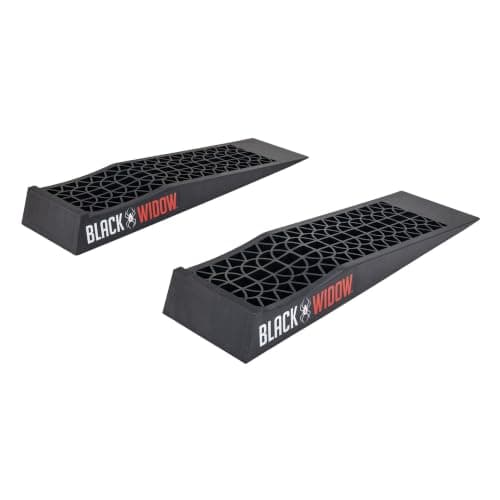
Black Widow Low-Profile Plastic Service Ramps (6009-V2)

Black Widow · score 8.0/10

A 9.05-degree loading angle at 4-1/2 lb per ramp — the gentlest approach angle you can buy cheaply, at the cost of only 2-1/2 in of lift.

A 9.05-degree loading angle and 2-1/2 in of lift at 4-1/2 lb per ramp. These are not service ramps — they are a way to raise the car 2-1/2 in so that a jack can finally get under the sill. That two-step approach is how genuinely low cars get lifted, and it costs a fraction of any jack. Capacity is 4,400 lb, so check your vehicle's weight first.

Published specifications

Capacity
5,000 lb per axle (10,000 lb GVW) Retail listing
Lift height
2-1/2 in Retail listing
Loading angle
9.05 degrees Retail listing
Dimensions
27-1/2 in x 7-3/4 in x 3 in Retail listing
Weight
4-1/2 lb per ramp Retail listing

What works

  • 9.05-degree angle is gentler than most ramps costing many times more
  • Honeycomb channels stop water pooling in storage
  • Light enough to carry in one hand

What you give up

  • 2-1/2 in of lift is a clearance aid, not a working height
  • A 10,000 lb GVW rating is the lowest here — check your vehicle's weight first
  • Long and thin, so it needs a flat run-up

Our scoring

  • Fit & reach7.8
  • Safety margin7.4
  • Beginner ease9.0
  • Build quality7.6
  • Value9.0
$47.99 · View on Amazon

#ad Price as of October 16, 2026. How this is funded

Specifications published by Black Widow — we earn nothing from that link.

Method

How these picks were chosen

We did not test these tools. We do not run a laboratory, we have not loaded a jack to failure or checked a wrench on a calibration bench, and we will not tell you otherwise. What we did instead is read the published manufacturer specifications, check the figures that matter against the safety standard that applies to portable automotive lifting equipment, and work out which tool suits which job. Every number on this page links to where it came from, so you can check us.

The five things we score are the five that decide a first purchase: will it fit under and lift your car, how much safety margin the rating and the locking mechanism leave you, how hard it is to get right alone in a driveway, what the materials and published standards say about how long it lasts, and what the money buys against the rest of the field.

Read the full method — including how we pick a top pick, and how prices get on the page.

Questions

Frequently asked questions

+Is there such a thing as a low profile scissor jack?

Not in any useful sense. A handful of listings use the phrase, but they are ordinary trunk-style scissor jacks — the mechanism's collapsed height is set by its arm length, so a genuinely thin scissor jack would have almost no lift and almost no base. For a low car, a low-profile hydraulic jack at around 3-1/2 in is the real answer.

+How low can a scissor jack go?

It varies by vehicle, because the jack supplied with a car is matched to that car's jacking point — which is why we are not going to quote a single figure. Check your own: the number stamped on it or printed in the owner's handbook is the only one that applies to you. In every case a low-profile floor jack starts lower.

+Can I use a scissor jack for an oil change?

Use it to lift, never to hold. If the only tool you own is the trunk jack, the honest answer is to buy a pair of ramps instead: they put the car on a solid base with no load transfer step, and they cost less than most stands. Car ramps for an oil change covers it.

+What is the lowest profile car jack I can buy?

Of the jacks on this site, the Pro-Lift F-767 publishes the lowest starting height at 3-1/2 in, with the F-757G a shade behind at 3-5/8 in and the Arcan A20019 at 3.75 in. Below about 3-1/2 in, no hydraulic jack fits and the ramps-first method takes over.

+Are scissor jacks safe?

For their intended job — a roadside wheel change with nobody under the car — yes, used on level ground at the manufacturer's jacking point. For working under a car, no jack of any type is safe, and a scissor jack is the least suitable of them because of its narrow base.

Sources

Where these figures come from

Read next

Related reading