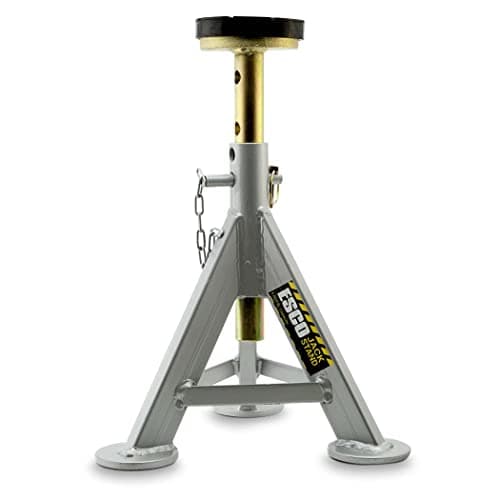
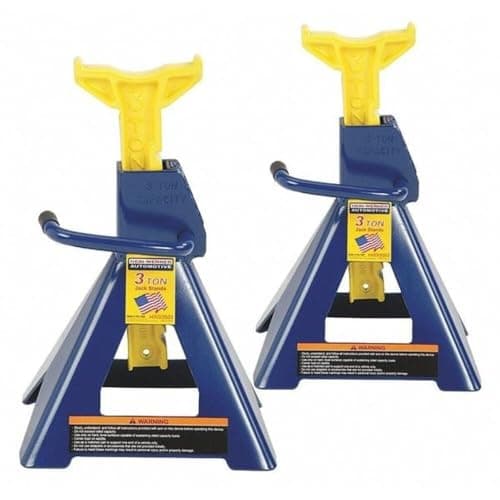
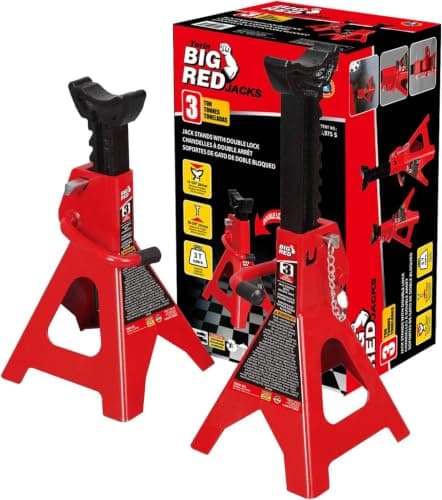
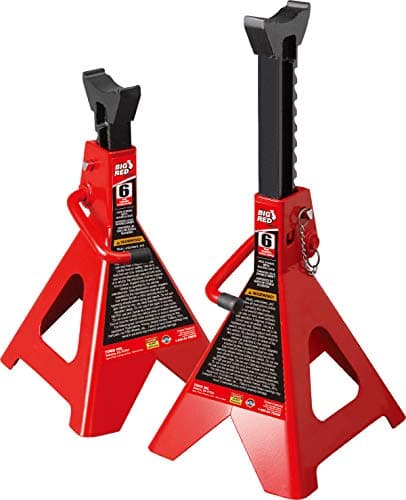
Top pick: for a body-on-frame SUV, the BIG RED T46002A 6-ton double-locking stands, because their 15-3/8 in to 23-13/16 in range is the only one here that reaches a tall frame rail. For a unibody crossover, the ESCO 10498 — 3 ton per stand, 13.2 in to 21.5 in, and the clearest published rating basis in the category. Tonnage is usually not what rules a stand out on an SUV. Height is.
An SUV is two different vehicles
The word covers a light unibody crossover built on a car platform and a body-on-frame truck with a wagon body, and they want different stands. The crossover supports like a car: reinforced sill points or pinch welds, a support height not far off a sedan's, and a weight a 3-ton pair handles easily. The body-on-frame vehicle supports on frame rails that sit well clear of the ground, weighs considerably more, and will often be out of reach of a stand that tops out at 17 in.
Work out which one you own before you shop. The owner's manual names the support points; if it shows a pinch weld or a sill notch, you have a unibody. If it shows a frame rail or an axle, you have body-on-frame — and the truck stand roundup is the closer match.
The four stands side by side
| Stand | Capacity | Rating basis | Height range |
|---|---|---|---|
| BIG RED T46002A | 6 ton (12,000 lb) | As published | 15-3/8 in - 23-13/16 in |
| ESCO 10498 | 3 ton | Per stand | 13.2 in - 21.5 in |
| Hein-Werner HW93503 | 3 ton | As published | 11-1/2 in - 17 in |
| BIG RED T43002A | 3 ton (6,000 lb) | Per pair | 11-1/4 in - 16-3/4 in |
The rating-basis column is the one to read twice. Two stands can both say "3 ton" on the box and mean numbers that differ by a factor of two. ESCO states 3 ton per stand; Torin states 3 ton per pair, which is 3,000 lb at each stand. Jack stand weight ratings works through the arithmetic with these same examples.
Why height rules first
The short version
- Measure from the floor to the support point your manual names, with the vehicle at normal ride height. That is the minimum the stand must reach.
- Then add the lift you need: a wheel off the ground, or room to get a drain pan and your shoulders underneath.
- A stand set near the bottom of its range is more stable than one wound out near the top. If you are at the top of a 17 in stand, you want a taller stand, not a braver setting.
- Your floor jack has to out-reach the stand setting you choose. On an SUV that often means a jack with 20 in or more of maximum lift.
That last point is where SUV jobs stall. A 3-ton jack topping out at 18 in can place a stand at 16 in comfortably; it cannot place a 6-ton stand near the top of its 23-13/16 in range at all. How high does a floor jack lift lists the published maximum for every jack on this site, and the SUV floor jack roundup is the matching lifting tool.
The capacity arithmetic for an SUV
Read the gross vehicle weight rating from the sticker on the driver's door jamb. That is the loaded figure, so using it is conservative. A pair of stands under one end carries roughly half of the vehicle, so halve the figure and compare it to the per-stand rating — not the per-pair headline. A 6,000 lb GVWR SUV puts about 3,000 lb across the pair at one end, or 1,500 lb per stand, which is inside a genuine 3-ton-per-stand rating by a wide margin and much closer to the limit on a 3-ton-per-pair set.
Where an SUV supports
On a unibody crossover the support points are the same reinforced sill sections a car uses, and the same caution applies: a bare pinch weld will fold under a flat saddle. Either use a stand with a notched saddle designed for a weld seam or protect the seam. The pinch weld guide covers both, and the pinch-weld stand roundup is the equipment answer.
On a body-on-frame SUV, support on the frame rail at the point the manual shows, with the stand saddle square across the rail rather than on an edge. Do not support a body-on-frame vehicle by the body sill — the body is not carrying that load path. Where to put jack stands goes through both cases with the manual as the authority.
What we would buy
Body-on-frame SUV: the 6-ton BIG RED set, for the height as much as the capacity, paired with a jack that reaches past 20 in. Unibody crossover: the ESCO 10498, because 3 ton per stand with a 21.5 in reach and a stated testing basis is the least ambiguous thing you can put under a vehicle. Mid-size crossover on a tight budget: the Hein-Werner HW93503, provided your support point sits inside its 17 in maximum. And whichever you buy, buy four, not two — how many jack stands do I need explains why that is cheaper than it sounds.