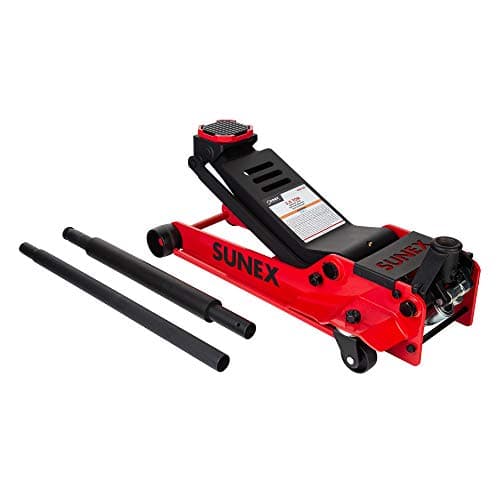
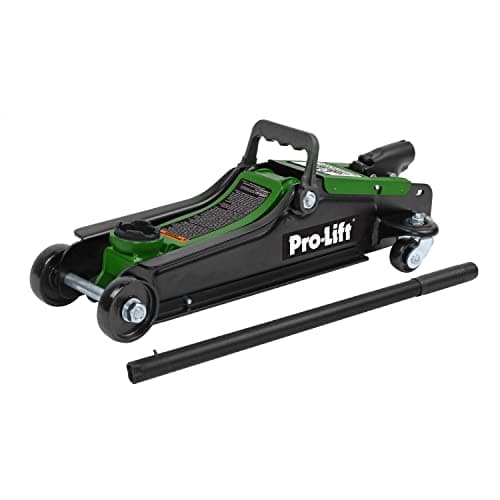
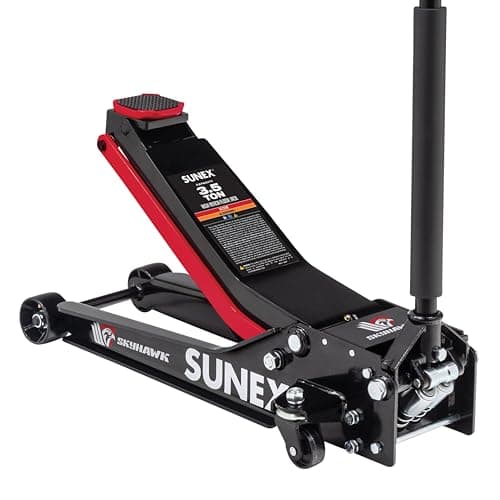
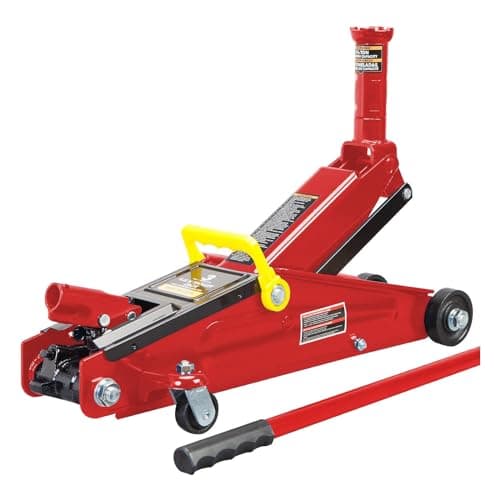
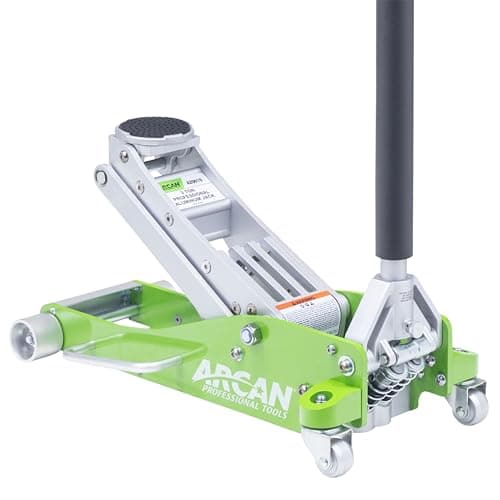
Short answer: the Arcan A20019. It starts at a published 3.75 in so it fits under a stock sedan as the car sits, and it lifts to 18 in, which is the part most jack roundups skip — your jack has to out-reach the jack stands you are going to rest the car on, or you cannot set the stands high enough to get a drain pan and your shoulders underneath. If your vehicle is a pickup or a tall SUV, the Sunex 66035HR and its 24.4 in of lift is the better buy. If money is the constraint, the Pro-Lift F-757G fits under the car at 3-5/8 in and you plan around its 13-3/8 in ceiling.
What we judged these on
1. Minimum saddle height, measured cold
This is the spec that decides whether the purchase was a waste. A jack whose saddle sits at 5-7/8 in cannot get under a sedan whose pinch weld is 4-1/2 in off the floor, and no amount of pumping changes that. Measure your own car before you buy: park on the flat, put a tape measure at the jack point named in your owner's manual, and read the gap. Do it with the car cold and the tires at normal pressure, because that is how it will be sitting on the morning you do the oil change. Low-profile floor jacks is the page for cars where the answer comes back under 4 in.
2. Maximum lift, against the stands you will buy
Here is the arithmetic nobody prints on the box. A common first set of 3-ton stands — the Torin T43002A — adjusts between a published 11-1/4 in and 16-3/4 in. To seat the car on the 16-3/4 in notch, the jack has to raise the lift point past 16-3/4 in, hold it there while you slide the stand in, and then lower onto it. A jack that tops out at 13-3/8 in physically cannot use the top half of that stand's range. It is not dangerous, but it does mean you work in the clearance the stand's lowest notches give you, and that is the difference between lying under the car comfortably and wedging yourself in.
3. How many strokes a full lift takes
An oil change lifts the car twice — once to set the stands, once at the end to retrieve them — and if you are rotating tires in the same session, more than that. A dual-piston or "rapid rise" pump reaches height in markedly fewer strokes than a single-piston one. Sunex states under six strokes to full height for the 66035SJ. This is not a safety criterion and we have not weighted it like one, but it is the criterion owners actually mention after a year.
4. Chassis length and where your jack point is
A long chassis puts the saddle further in under the car from where you kneel. Arcan publishes a 32 in chassis for the A20016; Sunex publishes an 18 in extended chassis for the 66035HR. That reach is useful if your vehicle's front lift point is a central crossmember rather than a side pinch weld — and it is a liability if your garage is narrow, because you need room behind the jack to pump the handle. Car jack points covers finding the right spot in the first place.
5. Capacity, which matters less than people assume
You are lifting one end of the car, not the whole car, and weight is not evenly split front to rear. For a typical sedan that puts well under half the curb weight on the jack, which is why a 2-ton jack is adequate for the job and a 3-ton jack is the default recommendation for headroom rather than necessity. Capacity becomes a real constraint on trucks and body-on-frame SUVs. Floor jack capacity guide does the arithmetic properly, and what size floor jack do I need answers it for specific vehicle types.
The five picks on published height
| Jack | Minimum height | Maximum lift | Capacity | Reaches a 16-3/4 in stand notch? |
|---|---|---|---|---|
| Arcan A20019 | 3.75 in | 18 in | 3 ton | Yes |
| Sunex 66035SJ | 3.85 in | 21.2 in | 3.5 ton | Yes |
| Pro-Lift F-757G | 3-5/8 in | 13-3/8 in | 2 ton | No |
| Sunex 66035HR | 3.58 in | 24.4 in | 3.5 ton | Yes |
| BIG RED T83006 | 5-7/8 in | 20-7/8 in | 3 ton | Yes |
The last column is the one to read if you are buying a jack and stands together. It compares each jack's published maximum against the published 16-3/4 in top setting of the Torin T43002A 3-ton stands, which is the set most first-timers end up with. Two of these jacks clear it with room to spare, one clears it comfortably, and one does not reach it at all.
How much height do you actually need?
More than you think, and less than a lift gives you. The things that have to fit under the car during an oil change are: a drain pan positioned under the sump, your forearms working a wrench on the drain plug, your head and shoulders if the filter is not accessible from above, and the filter itself coming out full of oil without tipping. None of those is a published dimension we can quote you, because they depend on your car, your drain pan and your build.
What we can tell you honestly is the shape of the decision. A car raised to the lowest notch of a set of 11-1/4 in stands is enough to reach a drain plug with your arm, and generally not enough to get your shoulders under a crossmember comfortably. A car on the 16-3/4 in notch is comfortable for most people. A low-profile drain pan — the wide flat kind rather than a bucket — buys several inches of that back. If you are at the limit, the alternative is to skip the jack entirely for this job: car ramps for an oil change raises the whole front of the car in one go, with no stands to position, and for a straight oil change on a car that fits them, ramps are the easier tool. Floor jack vs ramps is the honest comparison of the two.
Do you need to lift both ends?
For an oil change, almost never. The drain plug and filter are at the front on the overwhelming majority of cars, so the front axle up on two stands is the standard setup and the rear wheels stay on the ground and chocked. The exception is a car where the oil filter is reached from a mid-chassis access panel, or where you also want to rotate tires in the same session — then you are lifting all four corners, which is a different job with its own sequence. How many jack stands do I need works through both cases, and the first oil change tool list is everything else you need on the floor beside you.
One practical note on the drain-down. Oil drains faster and more completely warm, which is why the usual advice is to run the engine for a few minutes first — and a warm sump means a hot drain plug and hot oil. The car should be on its stands before any of that matters, but it is worth knowing that the sequence is lift, support, then drain, not drain in a hurry while the car is still on the jack.
What we left out, and why
We did not include a bottle jack. The Powerbuilt Unijack is a genuinely good lift-and-hold tool and it appears elsewhere on this site, but Powerbuilt publishes an 11 in minimum height, which means it will not fit under a car at all — it is a truck and SUV tool. Floor jack vs bottle jack covers that trade-off.
We also did not rank any jack on pump feel, build tolerances or how long it holds pressure, because we have not load-tested any jack on this site and we will not imply that we have. Every number above is a manufacturer or authoritative retail specification, linked in the sources, and every judgment layered on those numbers is labeled as ours. How we review sets out exactly what that does and does not buy you. Where a maker publishes no ASME PASE compliance statement, we say so rather than implying one exists — and on four of the five jacks here, there is none to quote.
What we would buy
For an oil change on a normal car: the Arcan A20019, because 3.75 in in and 18 in out is the pairing that lets you set the stands high and work in comfort, and because 56 lb is a weight you will not resent moving. Buy the 3-ton stands at the same time, not later. If you change your own oil often enough that the pumping annoys you, pay the difference for the Sunex 66035SJ. If the vehicle is a pickup or a tall SUV, the Sunex 66035HR for its 24.4 in of reach, or the BIG RED T83006 if you want the same height for less money and do not mind the extra strokes. And if the budget is fixed, the Pro-Lift F-757G will do the job on a sedan — you will just be working in the lower half of your stands' range.