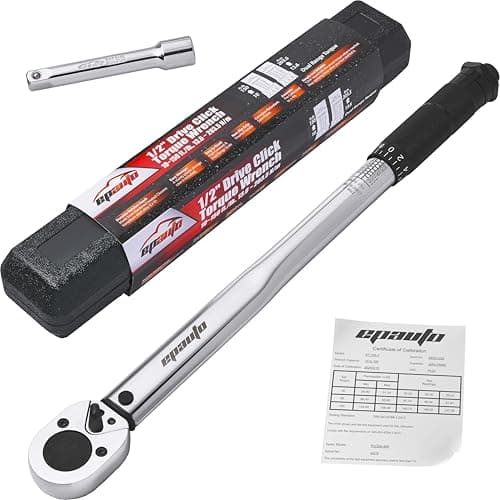
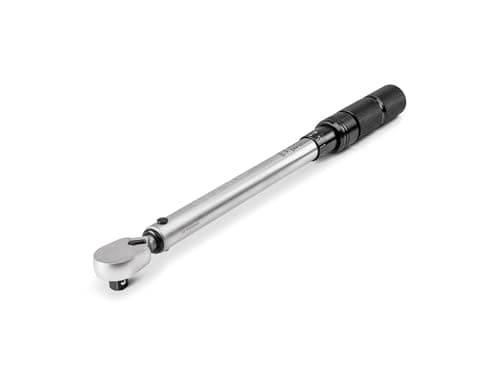
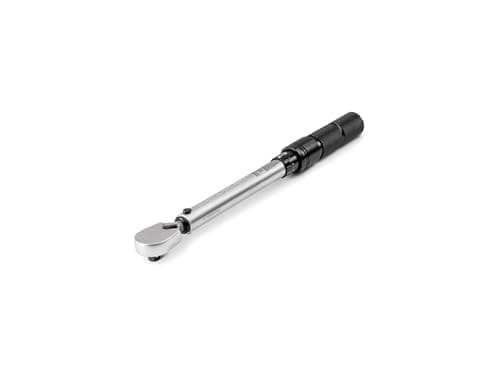
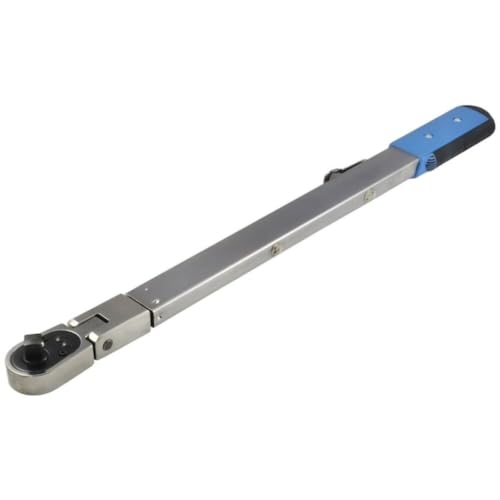
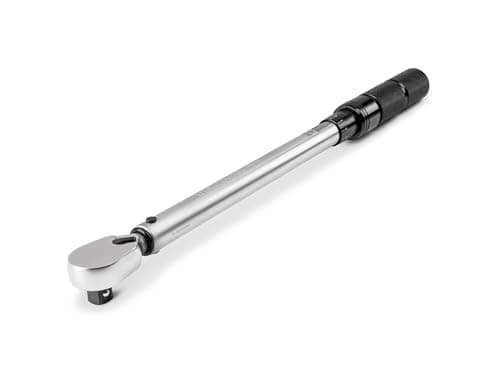
Short answer: the TEKTON TRQ52402 for most car work - 1/2 in drive, 40 to 200 ft-lb, a 90-tooth dual-direction head and a case. The budget pick is the EPAuto 1/2 in click wrench, which publishes a wider 10 to 150 ft-lb range and 1 ft-lb increments for a fraction of the price, at a stated 4% accuracy. If your fasteners are small, the TEKTON TRQ50402 is the only wrench here whose maker names ISO 6789-1:2017 and ASME B107.300-2021. And if you know you will forget to wind the wrench down, the Precision Instruments C3FR250F is a split beam and does not care.
What we judged these on
1. The published range, against the fasteners you own
A torque wrench is only accurate in the part of its scale it was designed for, so a wrench whose range does not cover your fasteners is the wrong wrench however good it is. Published ranges here: 40 to 200 ft-lb, 10 to 150 ft-lb, 10 to 100 ft-lb, 20 to 200 in-lb and 40 to 250 ft-lb. Lug nuts on a typical passenger car sit around 80 to 100 ft-lb - Capri Tools publishes values by thread size - so almost anything above covers them. A drain plug or a valve cover does not sit in the same universe. What size torque wrench do I need maps ranges to jobs.
2. The accuracy figure, and whether anyone names a standard
TEKTON publishes ±3% clockwise and counter-clockwise on the TRQ50402 and names ISO 6789-1:2017 and ASME B107.300-2021. Precision Instruments publishes ±4% on the C3FR250F with a dated calibration certificate. EPAuto's manual states pre-calibration to 4%. TEKTON does not publish a numeric accuracy figure for the TRQ52402 or TRQ51402 on the page we can read, and we have not invented one. A named standard with a certificate is the strongest claim available at this price level; no number at all is the weakest.
3. Increment size, because it decides how close you can get
A 1 ft-lb increment on the EPAuto lets you set 95 ft-lb exactly. A 5 ft-lb increment on the Precision Instruments wrench makes you choose between 95 and 100. On a lug nut that does not matter much; on a 25 ft-lb aluminum bracket, a 5 ft-lb step is a 20% choice. The inch-pound TRQ50402 publishes 1 in-lb increments, which is the finest resolution on the page by a long way.
4. The ratchet head, which is what you actually feel
TEKTON publishes a 90-tooth dual-direction head on the TRQ52402 and the TRQ50402, and a 4 degree swing arc on the latter. Tooth count decides whether you can tighten a bolt in a tight wheel well or an engine bay without removing and refitting the socket every few degrees. Dual direction matters for left-hand threads and for the rare counter-clockwise torque specification. Torque wrench vs ratchet explains why a torque wrench should not be used as a general-purpose ratchet anyway.
The five on published figures
| Wrench | Drive | Range | Stated accuracy | Increments |
|---|---|---|---|---|
| TEKTON TRQ52402 | 1/2 in | 40 - 200 ft-lb | Not published | Not published |
| EPAuto 1/2 in click | 1/2 in | 10 - 150 ft-lb | Pre-calibrated to 4% | 1 ft-lb |
| TEKTON TRQ51402 | 3/8 in | 10 - 100 ft-lb | Not published | Not published |
| TEKTON TRQ50402 | 1/4 in | 20 - 200 in-lb | ±3% CW/CCW, ISO 6789-1:2017 | 1 in-lb |
| Precision Instruments C3FR250F | 1/2 in | 40 - 250 ft-lb | ±4% | 5 ft-lb |
The clearest accuracy claim on this page belongs to the smallest and second-cheapest wrench, which is a useful reminder that the published figure follows the maker's documentation habits rather than the price.
Looking after a click wrench
Park Tool's use-and-care guidance covers the rules that keep a micrometer click wrench honest, and they are short. Wind it back to the lowest setting on the scale before you put it away, so the spring is not held compressed for months. Do not use it to loosen anything. Pull smoothly to the click and then stop - a second pull past the click is an unknown amount of extra torque. Do not add a pipe to the handle. And do not drop it; a click wrench that has been dropped has an unknown calibration until it is checked. How to check torque wrench calibration covers checking it, and does a torque wrench click once or twice answers the question everybody has on their first pull.
What we would buy
The TRQ52402 if you mainly rotate tires and do brakes, because 40 to 200 ft-lb with a 90-tooth head covers that work comfortably. The EPAuto if the budget is the constraint, because a published 10 to 150 ft-lb range with 1 ft-lb steps is more usable coverage per dollar than anything else here. The TRQ50402 as the second wrench, for everything measured in inch-pounds - and because it is the only one with a named standard and a certificate. The C3FR250F if you want a wrench you can put away without thinking about it.