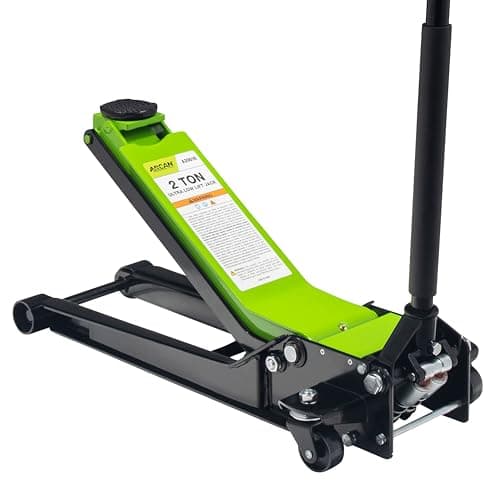
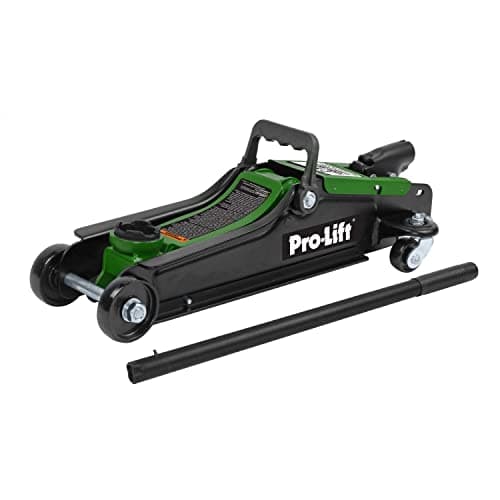
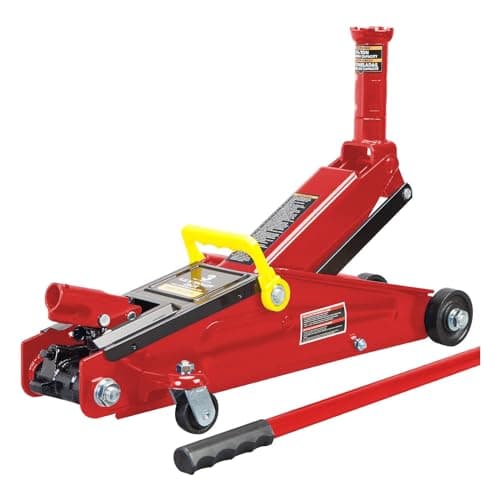
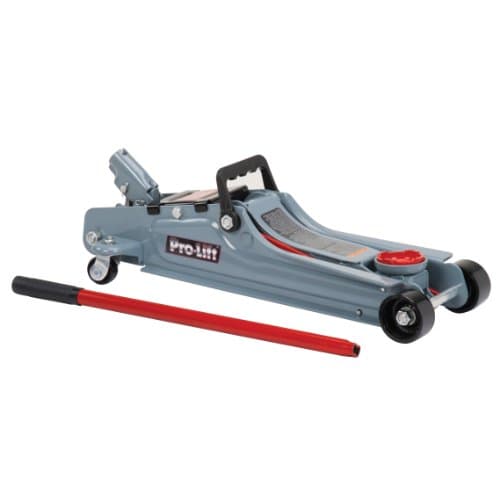
Short answer: the Pro-Lift F-767 for most cars - 2 ton, 3-1/2 in to 14 in, with a published safety valve and bypass. If your car sits low or you also want to reach a center lift point, the Arcan A20016 starts at 2.75 in and lifts to 24 in on the same 2-ton rating. The budget pick is the Pro-Lift F-757G: the cheapest jack here that still publishes a low enough start to get under a stock car. If you own a pickup or a tall SUV, stop reading and buy capacity you do not need for the lift height you do - the 3-ton BIG RED T83006 reaches 20-7/8 in.
What we judged these on
1. Minimum saddle height, because it decides whether you can start
Every other number on a jack listing is academic if the jack will not fit under the car. The published figures on this page span more than three quarters of an inch at the bottom: Arcan publishes 2.75 in on the A20016, Pro-Lift publishes 3-1/2 in on the F-767 and 3-5/8 in on the F-757G, and Torin publishes 5-7/8 in on the 3-ton T83006. On a stock sedan any of the first three will go under. On a car with an air dam or a lowered suspension, the difference between 2.75 in and 3-5/8 in is the difference between a tool and an ornament. Low-profile floor jacks is the page for that problem specifically.
2. Maximum lift, because it decides whether you can finish
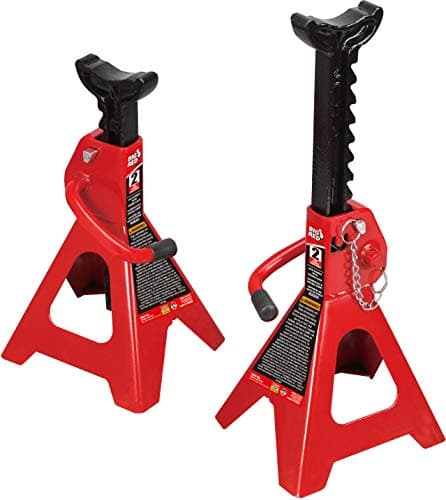
This is where 2-ton jacks separate from each other and from the 3-ton field. The F-757G tops out at 13-3/8 in, the F-767 at 14 in, and the A20016 at 24 in - a range of more than ten inches inside one capacity class. You need enough lift to raise the car past the height of the jack stand before you lower it on, so the ceiling has to beat your stand's setting with room to spare. Torin publishes 10.8 in to 16.5 in on the T42002A stands, which a 14 in jack can serve at the lower settings and cannot serve at the top. How high does a floor jack lift takes the clearance sum apart.
3. What the maker publishes about overload
A hydraulic jack should refuse a load it cannot handle rather than fail under it. Pro-Lift publishes a built-in safety valve and bypass on the F-767 and an overload valve bypass system on the F-757G; Torin publishes a safety bypass system on the T83006. Those are published statements, not test results we ran. US portable service equipment is covered by ASME PASE, and whether a maker names the standard at all is a signal worth reading - though on this page none of the 2-ton jacks publishes a PASE compliance statement, and we are not going to pretend otherwise.
4. The weight you have to move
A jack you do not want to drag out is a jack you will not use. Pro-Lift publishes 22 lb on the F-757G. Arcan publishes 92.59 lb on the A20016. Both are 2-ton jacks. That is a four-fold difference in the thing you handle every time, and it is the single most underrated spec on a jack listing for a home garage with a step down into it.
The 2-ton field on published figures
| Jack | Capacity | Lift range | Weight | Overload statement |
|---|---|---|---|---|
| Pro-Lift F-767 | 2 ton | 3-1/2 - 14 in | Not published | Safety valve and bypass |
| Arcan A20016 | 2 ton (4,000 lb) | 2.75 - 24 in | 92.59 lb | Not published |
| Pro-Lift F-757G | 2 ton (4,000 lb) | 3-5/8 - 13-3/8 in | 22 lb | Overload valve bypass |
| BIG RED T83006 (3 ton) | 3 ton (6,000 lb) | 5-7/8 - 20-7/8 in | Not published | Safety bypass system |
Read the third column, not the second. Every jack in the table out-rates what a car puts on it; only one of them reaches a truck.
Is a 2-ton jack enough?
For a car, almost always. For a truck, almost never - but not for the reason people assume. A half-ton pickup can weigh over 5,000 lb, and a 2-ton jack is rated at 4,000 lb, so on paper the margin looks thin. In practice you are lifting one corner, and the real wall you hit is the 13-3/8 in or 14 in ceiling on a vehicle whose frame rail sits above that unloaded. The jack runs out of travel long before it runs out of rating. Where to jack up a truck covers the lift points, and best floor jack for lifted trucks is the roundup for that vehicle.
The sensible reading of the rating is as margin for the things you cannot control: a saddle that is not quite centered, a car that settles as a suspension arm unloads, a sill that flexes. Buying a 3-ton jack for a Civic does not make the Civic safer - it makes the jack heavier. Buying stands rated and tall enough for the car does make it safer, which is why the stands are on this page at all.
What we left out, and why
We have not load-tested any jack on this site and will not imply we have. Every figure above is published by the manufacturer and linked in the sources; the ranking is editorial judgment applied to those figures, and how we review says exactly what that is worth. We also left out the 2-ton scissor and bottle jacks sold as emergency equipment: they are not service jacks, they have no wheels, and they do not belong under a car you intend to work on. Floor jack vs bottle jack explains the difference.
What we would buy
For a normal car and a first purchase: the Pro-Lift F-767, with a pair of T42002A stands bought at the same time so the heights agree. For a low car, or if you want one jack that also reaches a center lift point: the Arcan A20016, accepting the weight. On the tightest budget that still works: the F-757G, as long as your car is low enough that 13-3/8 in gets the wheel off the ground. And if the vehicle is a truck, buy the 3-ton T83006 for the lift height and treat the extra tonnage as a side effect.