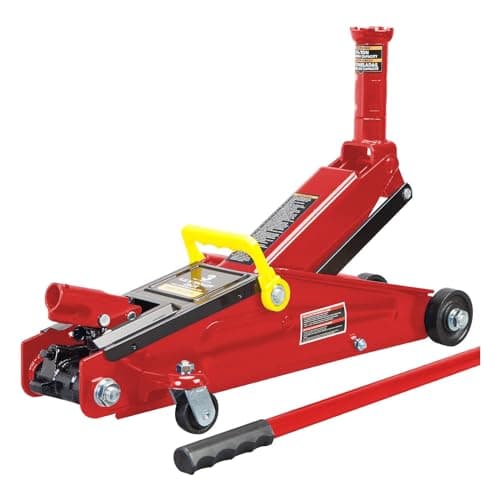
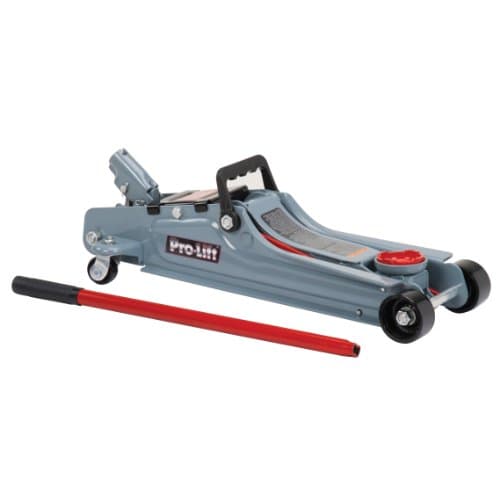
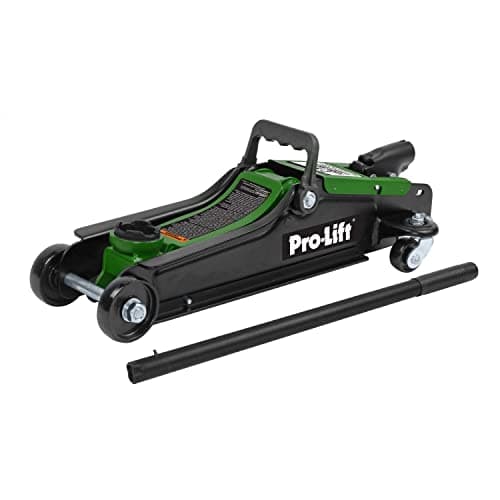
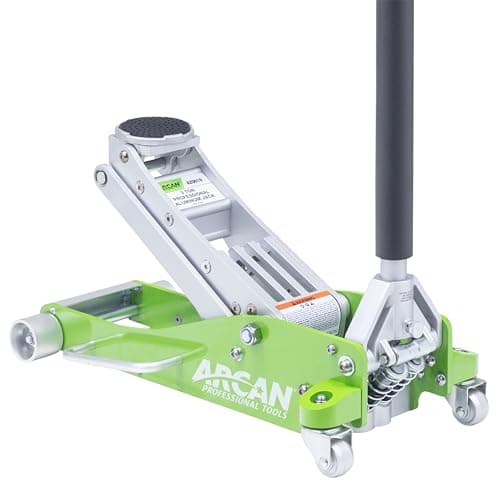
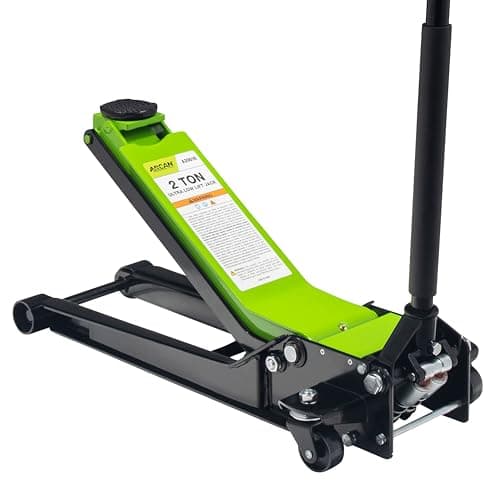
Short answer: the Arcan A20016 is the best steel floor jack we cover - 2.75 in to 24 in on a 32 in steel chassis, which is a range no other steel jack here comes close to. The best value in steel is the Torin BIG RED T83006, the cheapest way to get past 20 in of lift, as long as your car accepts its 5-7/8 in minimum height. For an ordinary car the Pro-Lift F-767 is the sensible steel jack at 3-1/2 in to 14 in. The budget pick is the Pro-Lift F-757G: the cheapest steel jack here that still starts low enough to get under a stock car, and at 22 lb the lightest jack on the page by a wide margin.
What we judged these on
1. Whether the maker publishes a material at all
This page only features jacks whose own specification says what they are made of, which turned out to be a smaller list than expected. Arcan publishes steel on the A20016 and aircraft-grade aluminum on the A20019. Torin publishes steel on the T83006. Pro-Lift publishes steel on the F-767 and the F-757G. Several other jacks we cover - the GEARWRENCH GWLPFJ3T, the Sunex 66035HR Skyhawk, the Powerbuilt Unijack - publish no material statement on the pages we can read, so they are not on this page. Their absence is a fact about the documentation, not a judgment about the jacks, and we are not going to assume a material in order to pad a roundup.
2. Weight, which is the real cost of steel
The published weights here tell the story better than any marketing copy: 22 lb for the Pro-Lift F-757G, 56 lb for the aluminum Arcan A20019, 92.59 lb for the steel Arcan A20016. Steel does not automatically mean heavy - the lightest jack on this page is steel - but at a given capacity and reach it always means heavier than the aluminum equivalent. The A20016 and the A20019 are the clean comparison: same brand, same design language, 92.59 lb against 56 lb. That 36 lb is the thing you are buying or declining.
Why it matters more than it sounds: a jack that lives in a garage bay and never moves can weigh whatever it likes. A jack that has to come down a step, out to a driveway or into a trunk gets left behind at about the point where you stop wanting to pick it up. Two of the five jacks here publish no weight at all, which is genuinely annoying on a spec sheet where it is one of the two numbers that decides the purchase.
3. Lift range, bottom and top
A jack only fits your car if it clears both ends of a simple sum: low enough to go under the sill, high enough to raise the car past the notch you intend to set your stands at. Published minimums on this page run 2.75 in, 3-1/2 in, 3-5/8 in, 3.75 in and 5-7/8 in. Published maximums run 13-3/8 in, 14 in, 18 in, 20-7/8 in and 24 in. That is a spread of more than ten inches at the top, inside what is nominally one category. Torin publishes 11-1/4 in to 16-3/4 in on its common 3-ton stands, so a jack stopping at 13-3/8 in can only serve the bottom of that range. How high does a floor jack lift works the clearance arithmetic through properly, and best high-lift floor jacks is the page if the ceiling is your constraint.
4. What the maker publishes about overload
A hydraulic jack should refuse a load it cannot take rather than fail under it, and the only honest evidence available to a buyer is what the maker states. Pro-Lift publishes a built-in safety valve and bypass on the F-767 and an overload valve bypass system on the F-757G. Torin publishes a safety bypass system on the T83006. Arcan publishes no overload statement for either the A20016 or the A20019. US portable service equipment falls under ASME PASE, and - worth saying plainly - not one jack on this page publishes a PASE compliance statement. The jacks we cover that do name the standard are the GEARWRENCH GWLPFJ3T (meets ASME PASE-2019) and the Sunex Skyhawk (PASE compliant), and neither publishes a material.
5. Chassis length, the spec almost nobody reads
Travel raises the saddle; chassis length gets the saddle to the lift point. Arcan publishes a 32 in extra-long chassis on the A20016, which is why that jack can reach a center lift point well inboard of a rocker panel. Nobody else on this page publishes a chassis length at all. If your car has a mid-chassis lift point rather than a sill pinch weld, this is the figure that decides whether the jack can be used at all - do I need a long reach floor jack works out whether you are in that case.
6. The wheels, because a heavy jack lives or dies on them
The heavier the jack, the more the casters matter, and almost nobody publishes them. Pro-Lift does: two fixed steel casters and two swivel casters on the F-757G. Fixed rears and swivel fronts are what let a jack roll straight in and then pivot to line the saddle up. On a cracked or painted garage floor, small hard wheels bind on every seam - and a 92 lb jack that will not roll smoothly is a two-handed job every single time.
The five on published figures
| Jack | Material | Capacity | Lift range | Weight |
|---|---|---|---|---|
| Arcan A20016 | Steel | 2 ton (4,000 lb) | 2.75 - 24 in | 92.59 lb |
| BIG RED T83006 | Steel | 3 ton (6,000 lb) | 5-7/8 - 20-7/8 in | Not published |
| Pro-Lift F-767 | Steel | 2 ton | 3-1/2 - 14 in | Not published |
| Pro-Lift F-757G | Steel | 2 ton (4,000 lb) | 3-5/8 - 13-3/8 in | 22 lb |
| Arcan A20019 | Aircraft-grade aluminum | 3 ton (6,000 lb) | 3.75 - 18 in | 56 lb |
Read the last two columns together and the page answers itself. The widest range belongs to the heaviest jack. The lightest jack has the narrowest range. The aluminum row is the only one that buys back weight without giving up capacity, and it does it by giving up six inches of ceiling.
Is a steel jack stronger than an aluminum one?
Not in any sense a published specification supports, and this is where most writing on the subject goes wrong. Both jacks on this page from the same maker are rated by that maker: the steel A20016 at 2 ton and the aluminum A20019 at 3 ton. The aluminum jack carries the higher rating. Rated capacity comes from the design and the test the maker applies, not from the periodic table, and anyone telling you steel is inherently stronger is comparing materials rather than products.
What is true, and duller: aluminum costs more per pound of structure, so for the same money a steel jack can be built with more material in it. That is why cheap jacks are steel and why the lightest jacks are aluminum. It is also why a steel jack at a given price usually has a longer warranty-free life as a dropped-on, knocked-about shop tool - though no maker on this page publishes anything that would let us prove it, so we are not going to claim it as a finding. Safest floor jacks ranks the whole field on published standards compliance rather than on material.
Who should buy steel, and who should not
Buy steel if the jack is going to live where you use it. A garage bay with a flat slab, a dedicated corner, a workshop - in those places the weight is somebody else's problem and you keep the money. Buy steel if you want the most lift range per dollar, because every jack on this page that reaches past 20 in is steel and the cheapest of them is a long way under the aluminum jacks. And buy steel if the budget is the real constraint: the F-757G is the cheapest usable jack we cover and it is both steel and 22 lb.
Buy aluminum if you will have to lift the jack itself. A step down into the garage, a shared parking space, a driveway you walk the tools out to, a car you want the jack to travel with - those are the cases where 56 lb beats 92.59 lb every time, and the 36 lb difference is the entire product. Best car jack to keep in your car is the extreme version of that argument, and best floor jack for the money weighs the whole field on specification per dollar rather than on material.
What has to be bought alongside it
No jack on this page, in any material, is a support device. A hydraulic ram holds pressure until it does not, and a release valve is a thing that can be knocked. The jack raises the car; a pair of stands holds it. Check before you order that your jack's maximum lift beats the notch you intend to use - a 13-3/8 in jack cannot serve a stand set at 16-3/4 in. Floor jack and jack stand combo matches the heights for you, and best jack stands under $100 is the budget version of the supporting half. A pair of chocks for the wheels that stay on the ground is the other purchase almost everybody skips.
What we left out, and why
We have not load-tested any jack on this site and we are not going to imply we have. Every figure above is published by the manufacturer and linked in the sources; the ranking is editorial judgment applied to those figures, and how we review says exactly what that is worth. We also left out every jack whose maker does not publish a material, which on this site is four of the nine jacks we cover - including two of the best ones. Putting them here would have meant guessing at steel from a photograph. And we left out steel bottle and scissor jacks entirely: they are emergency and support tools rather than service jacks, and floor jack vs bottle jack explains the difference.
What we would buy
For a car that sits low, or any car with an inboard lift point: the Arcan A20016, accepting 92.59 lb as the cost of 2.75 in to 24 in on a 32 in chassis. For a crossover, truck or anything with normal ride height where price matters: the Torin T83006, which gives more lift per dollar than anything else we cover. For an ordinary sedan and a first purchase: the Pro-Lift F-767. On the tightest budget that still works: the F-757G, as long as 13-3/8 in gets your wheel off the ground - and buy low-starting stands at the same time so the pair actually works together. And if you are going to be carrying the jack rather than rolling it, stop reading about steel and buy the aluminum A20019.