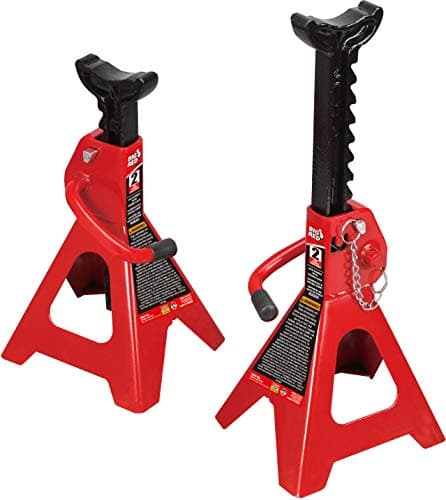
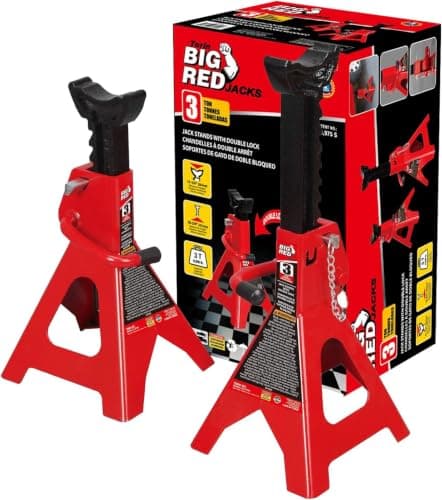
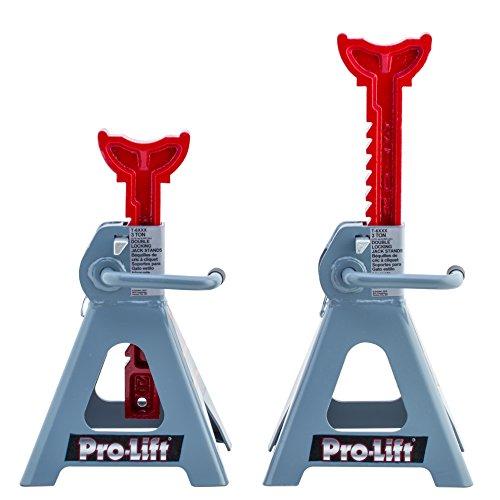
Short answer: the Pro-LifT T-6903D is the best jack stands under $50 - 3 ton, 11 in to 17 in, a cast ductile iron ratchet bar with counter-weighted pawls, and a stated ANSI/PALD compliance claim. The budget pick is the BIG RED T42002A, which is both the cheapest set here and the one naming the most specific standard, ASME PASE-2019, with the lowest minimum height we can point you at. The BIG RED T43002A is the pick if you want the classic 3-ton-per-pair set with a published base footprint. The useful headline for this band: nothing important is missing at $50. Every price cell in the table above is read from the live listing and stamped with the date it was read.
What we judged these on
1. Rating basis, before tonnage
"3 ton" means two completely different things in this band and the small print is where the difference lives. Torin publishes 3 ton per pair on the T43002A - which is 1.5 ton at each corner you support - and 2 ton each on the T42002A. Pro-Lift publishes 3 ton for the T-6903D pair without stating the basis, so we read it as the conservative figure. For context, supporting two corners of a 4,000 lb car puts roughly 1,000 lb on each stand, so every option here has real margin. You can only see that margin if the basis is stated, which is why it is the first column rather than the headline. Jack stand weight ratings works through the arithmetic for each basis.
2. The minimum height, which is what silently disqualifies a stand
A stand has to slide under the support point after the jack has lifted it, so the lowest setting is a hard filter rather than a preference. Torin publishes 10.8 in on the T42002A and 11-1/4 in on the T43002A; Pro-Lift publishes 11 in on the T-6903D. On a low car those two or three inches decide the job. Measure the gap at your own support point with the car on the ground, then add the lift you expect, before you choose a number. Best jack stands for low cars is the low end of this problem in detail.
3. One lock or two
All three sets here publish two independent mechanisms, which is the single best thing about this price band. Torin publishes a ratchet support bar plus a separate safety pin on both models, and names a 10-level ratchet with a double locking pin on the T42002A. Pro-Lift publishes a handle lock plus a mobility pin, and goes further than either Torin listing by naming counter-weighted pawls as the anti-disengagement device. A second lock is what holds if the first is knocked out of engagement - which is the realistic failure, not a casting snapping. Pin vs ratchet jack stands compares the mechanisms, and best double-locking jack stands covers the pattern with no price cap.
4. Which standard the maker will name
The wording is the signal, and in this band it is unusually good. ASME PASE-2019 is the safety standard for portable automotive service equipment - the document defining how a stand is loaded, held and proof-tested. Torin names it by revision on the T42002A, which is the strongest claim on this page, and uses more general ASME wording on the T43002A. Pro-Lift states the T-6903D meets or exceeds ANSI/PALD, a different but real standards family. None of the three carries the accredited third-party testing claim that appears a band higher, and we say so rather than implying otherwise. Safest jack stands grades every model we cover on exactly this wording.
The three inside the cap, on published numbers
| Stand | Rating basis | Height range | Standard named |
|---|---|---|---|
| Pro-LifT T-6903D | 3 ton (basis not stated) | 11 in - 17 in | ANSI/PALD |
| BIG RED T42002A | 2 ton (4,400 lb) each | 10.8 in - 16.5 in | ASME PASE-2019 |
| BIG RED T43002A | 3 ton per pair | 11-1/4 in - 16-3/4 in | ASME (revision not stated) |
Read the first and third columns together. The set with the most capacity does not name the most specific standard, and the set naming the most specific standard has the least capacity - which is the honest trade inside this cap rather than a reason to spend more.
What the cap actually costs you
Three things, none of them a mechanism. The first is a rating published per standrather than per pair, which removes the guesswork from your load arithmetic; that starts at the ESCO 10498 in the band above. The second is accredited third-party testing - ESCO states ASME testing by an A2LA-certified facility, and nothing under $50 makes an equivalent claim. The third is saddle shape: a removable flat rubber cushion sits against a unibody sill without digging in, where every stand in this band has a conventional notched saddle, which is why pads exist. Best jack stand pads covers that fix for a few dollars. What the cap does not cost you is a second lock, a named standard, or a height range that fits an ordinary car.
Two pairs, not one pair, for a lot of jobs
Worth planning for while the numbers are this small. A pair supports one axle, which covers an oil change, a brake job on one end, or a wheel-off inspection at the front. A tire rotation, a fluid change that needs the car level, or any job where you move between both ends needs four stands - and at this price two pairs is still less than one mid-range set. If you buy two pairs, buy two pairs of the same model: mixing a 10.8 in minimum set with an 11-1/4 in minimum set makes levelling the car harder than it needs to be. How many jack stands do I need covers when two is enough and when it is not.
What we would buy
The Pro-LifT T-6903D for most cars: 3 ton of capacity, an 11 in to 17 in range that matches what a budget floor jack can reach, counter-weighted pawls named as the locking device, and a stated ANSI/PALD claim - accepting the 90-day warranty as the price of the price. The BIG RED T42002A if your car sits low, because 10.8 in is the number that decides it, and because it names ASME PASE-2019 by revision while costing the least on this page. The BIG RED T43002A if you want the published base footprint and the classic 3-ton pair. And whichever you choose, buy the stands before you buy a better jack: the jack lifts the car, but these are what let you get under it.